
Note: I am referring the original Marathi Ovi version of the Shri Sai Satcharita, beautifully translated by Mrs. Indira Kher. No copyright infringement is intended. These reflections and interpretations are drawn from my personal experience, devotion, and evolving understanding of Baba’s teachings and unceasing grace. I fully respect that others may hold different views or insights, and I welcome the diversity of devotion. However, I retain the creative and devotional agency to express myself freely on this blog, which is a heartfelt offering to my One and Only, Satchidananda Sadguru Sainath Maharaj of Shirdi.
With Love, Priyanka
Since writing the previous post, in which I said some things that I felt needed to be said, I have wondered whether I did the right thing. As a seeker, I feel it is my responsibility to share whatever pitfalls or dangers I have perceived on the path and have watched fellow seekers fall into. Condemnation and argumentation, however, are not in my nature unless they become absolutely necessary. I am also very much a nobody when it comes to speaking about spirituality, teachers and matters of this kind, and I have no desire to position myself as an authority on anyone’s spiritual life. Yet I find it tremendously important to leave the light on for whoever may be searching for an answer.
That said, I went to sleep last night after asking the universe for some affirmation that I had done the right thing by posting something that many people may not even find particularly troubling. I admit that people act according to their own conditioning and that Maya itself has an extraordinary capacity to veil discernment. Still, a student has to remain mindful. Vigilance is an integral part of the path. I am not saying that any particular teacher is good or bad but choose wisely. Everyone has their purpose, their place and their karma. A teacher may be perfectly suited to one person and completely unsuitable for another. The responsibility of the seeker is therefore not to condemn every teacher, nor to surrender discernment simply because someone has been placed in the role of Guru. It is to keep ones eyes open.
I remember listening to a satsang in which someone shared how their life had been severely disrupted after becoming involved with what they believed was the wrong teacher and spiritual organisation. In another account, someone described a Kundalini awakening that his teacher was unable to understand or handle, leaving his daughter in an altered and severely impaired state akin to coma for three years. Whether every detail of such stories can be independently established is beside the larger point. Spiritual practices can have profound psychological, somatic and experiential effects, and a teacher who lacks the maturity, knowledge or discernment to guide a student through them can cause real harm.
There are enough such stories in the world that I do not feel the need to say much more about this. I would rather conclude the subject here, once and for all, with something far more authoritative than my own apprehensions. Since so much of my meditation lately has revolved around understanding the greed, ignorance and aversion that keep the wheel of dependent origination, held by Lord Yama, turning, I felt strangely grateful today when, while going through a random commentary by chance on the Kaṭha Upaniṣad by Swami Nirmalananda Giri, I came across Yama speaking about teachers with a directness that was almost a thousand times greater than anything I had written.
It felt like a little pat on the back from Lord Yama himself.
Yama tells Nachiketa:
“Na nareṇāvareṇa prokta eṣa suvijñeyo bahudhā cintyamānaḥ; ananyaprokte gatir atra nāsti, aṇīyān hy atarkyam aṇupramāṇāt.”
The Self is not easily understood when taught by an inadequate person, for it is thought of in many ways. When taught by one who knows it as non-different from himself, there is no going astray. It is subtler than the subtle and beyond mere reasoning.
Kaṭha Upaniṣad 1.2.8
And Yama follows this by saying:
“Naiṣā tarkeṇa matir āpaneyā, proktānyenaiva sujñānāya preṣṭha.”
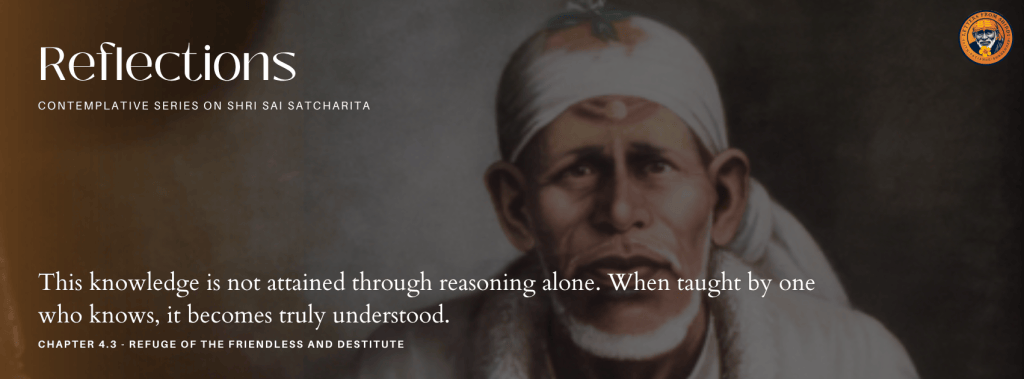
This knowledge is not attained through reasoning alone. When taught by one who knows, it becomes truly understood.
Kaṭha Upaniṣad 1.2.9
This is exactly the distinction I was trying, rather inadequately, to make in my previous post. The Self is subtler than anything the intellect can turn into an object of analysis. One can accumulate books, vocabulary, philosophies, techniques, followers and even impressive spiritual experiences, yet remain entirely within theory. A teacher can be extraordinarily articulate and still only be transmitting concepts about something they have not directly realised. A realised one gives the student a map and also show them how to walk. They direct the seeker towards the means by which that truth can become immediate and lived, instead of just providing an empty philosophy of Self-realisation. Yama’s criterion is therefore far more demanding than eloquence, charisma, scholarship or the ability to produce mystical experiences. The teacher has to and MUST know.
And even that word, “know,” needs to be understood rather carefully. It does not mean knowing more books than everyone else but the direct knowledge of the Self, the recognition of the non-difference between Ātman and Brahman. The Upanishadic teacher points the student towards that recognition rather than making himself the final object of fascination, as I wrote previously.
There is another verse that makes this even more humbling:
“Nāyam ātmā pravacanena labhyo na medhayā na bahunā śrutena…”
This Self is not attained through discourse, intellect or much hearing.
Kaṭha Upaniṣad 1.2.23
Although, this does not diminish study, intellect or scripture but it does show their eventual insufficiency. They can orient us and refine our understanding and even prevent us from wandering into confusion, but the Self cannot be reduced to an intellectual possession especially for someone whose providential dispensation is cerebral. This is also why the warning about teachers matters so much. A wrong teacher can give you the wrong map with faulty or illusory territory and then convince you that your inability to reach the destination is your own spiritual failure. A charismatic teacher can mistake their psychological (often times manipulative) influence for spiritual authority and a gifted rhetorician can make their imagined figures of light and speculation sound like realisations. Someone with genuine psychic or energetic experiences can interpret them as proof of Self-knowledge and one who has gathered thousands of followers can begin to mistake fickle popularity for Truth. So on and so forth.
And a seeker who desperately wants to believe can help the teacher do all of this. THAT is where discernment becomes a form of compassion towards oneself.
Sri Dhabolkar ji expresses the other side of this beautifully while describing the transformative power of saints. He compares the saint to the Pārees, the philosopher’s stone, which turns iron into gold merely through contact. Yet even this analogy falls short, because the saint transforms the devotee completely, raising them towards his own exalted state. He describes the devotee eventually transcending distinctions and seeing Brahman reflected throughout the entire universe, animate and inanimate, recognising the glory of creation as the undivided glory of Brahman. When this realisation arises and nothing is experienced as separate from the Self, hostility and fear themselves lose their foundation.
This is the kind of transformation I understand the Guru to represent. The true Guru does not make you feel spiritually special and makes separation less believable. And this is why I am concluding the question of “good teacher versus bad teacher” here. There will always be teachers, seekers, institutions, traditions and differing paths. I have no interest in turning this into a “my Guru is better than your Guru” conversation. I really do not care. I do not believe spirituality becomes purer by comparing Gurus or collecting spiritual hierarchies but find this to be a kind suggestion from your seeker sister. Maybe, this will stop you in your tracks when you are about to fall into a pit, God forbid.
Lastly, when it comes to describing the kind of Guru who is God-realised, my mind leaves me with very few words. An ignoramus like me can read, study, compare and write endlessly and still barely touch the edge of what that relationship means. Dhabolkar ji himself eventually reaches the same place of speechlessness. He writes that speech in all its four stages, parā, pashyanti, madhyama and vaikhari, fails to describe Him. The Vedas, with all their wisdom, also fall silent and take refuge in neti neti, “not this, not this.” The six darshanas, the six shastras, the Puranas and kirtan all exhaust their attempts at describing Him. What remains, he says, is pranama, surrendering to Him through our actions, speech and thought.
I hope and pray, all sincere seekers find realised teachers. I hope and pray, if that is not to be, may the seeker find the teacher within. Entire universe will then become the teacher, and sacred allies from all realms will come seeking him to impart their wisdom and realise the Self.
|| OM SAI SHRI SAI JAI JAI SAI ||
|| SHRI SATCHIDANANDA SADGURU SAINATH MAHARAJ KI JAI ||
Notes:
Sources Referred To
- Kaṭha Upaniṣad, commentaries by Ādi Śaṅkarācārya and Swami Nirmalananda Giri.
Glossary as explained in Satcharita:
Parā: Speech in its first and most subtle stage, representing the initial stirring of prāṇa or breath, symbolised by the sacred syllable Om.
Paśyantī: Speech in its second stage, located in the Antaḥkaraṇa (the inner instrument or mind) and characterised by Viveka, or discrimination.
Madhyamā: Speech in its third stage of development, said to have its seat in the trachea.
Vaikharī: Speech in its fourth and most manifest stage, expressed as articulate verbal utterance.
The Ṣaḍ-Darśanas
The six orthodox schools of Indian philosophy are: Sāṃkhya, Yoga, Nyāya, Vaiśeṣika, Mīmāṃsā, Vedānta
Strictly speaking, the Ṣaḍ-Darśanas and the “six Śāstras” can refer to the same six philosophical systems. However, śāstra is sometimes used more loosely in the sense of Vedāṅga, in which case it refers to the six auxiliary disciplines of Vedic study: Śikṣā – phonetics and pronunciation, Chandas – metre, Vyākaraṇa – grammar, Nirukta – etymology and interpretation of words, Jyotiṣa – astronomy and astrology, Kalpa – ritual and ceremonial practice
The Purāṇas: A Purāṇa is a sacred or poetic work comprising a major body of Hindu mythology, cosmology, genealogy and sacred history. Traditionally, there are eighteen Mahāpurāṇas, each traditionally associated with five principal subjects: creation, dissolution and renewal of the worlds, genealogies of gods and heroes, the reigns of the Manus, and the histories of their descendants.
The eighteen traditionally recognised Mahāpurāṇas are: Brahma, Padma, Viṣṇu, Śiva, Liṅga, Garuḍa, Nārada, Bhāgavata, Agni, Skanda, Bhaviṣya, Brahmavaivarta, Mārkaṇḍeya, Vāmana, Varāha, Matsya, Kūrma and Vāyu.
Kīrtan: Kīrtan is the devotional singing or chanting of God’s names and praises, generally accompanied by music. It is both a form of bhakti and a means of collective remembrance of the Divine.
Note: Since the chapters are long and stretch across many ovis, I will be breaking them down in a way that allows us to go deep without losing track. Each reflection will cover either a single concept, a leela, or at most 50 ovis – whichever completes a thought fully. This way, we can sit with every aspect of the Satcharita as carefully and reverently as possible, without skipping a single detail, guided always by Baba’s grace. I’ve also chosen this approach because very long posts can feel heavy or overwhelming for some devotees. Keeping them snack-able and focused will hopefully make it easier for everyone to read, return to, and reflect on in their own pace. All rights reserved.
 Letters From Shirdi
Leave a comment