
Note: I am referring the original Marathi Ovi version of the Shri Sai Satcharita, beautifully translated by Mrs. Indira Kher. No copyright infringement is intended. These reflections and interpretations are drawn from my personal experience, devotion, and evolving understanding of Baba’s teachings and unceasing grace. I fully respect that others may hold different views or insights, and I welcome the diversity of devotion. However, I retain the creative and devotional agency to express myself freely on this blog, which is a heartfelt offering to my One and Only, Satchidananda Sadguru Sainath Maharaj of Shirdi.
With Love, Priyanka
This chapter, “Descent of Sai Samarth in Shirdi” mentions, according to the author, why saints have to descend on earth, or rather, what difficult task necessitates their incarnating in this human form. In this reflection, I will relay a bit of the author’s perspective on why saints incarnate and how I understand who a true saint is, and the reason for their incarnation. Sri Dhabolkar ji was a guileless, devout, simple Brahmin; his view is humble and scriptural, but not without faith. He cites assertions from the scriptures and says that when adharma takes over dharma, when righteousness is used as a disguise to secretly perpetuate oppression and tyranny, to stoke the embers of hatred between religious sects, exasperating the common folk, and when dharma declines, certain conditions arise. He gives examples from the scriptures of people failing to attain enlightenment and wasting away in physical pleasures, usurping the rights of others, laxity in observing personal dharma, and so on. Basically, when gluttony, greed, lust, wrath, envy, sloth and pride are on the rise, saints incarnate to restore balance, eradicate unrighteousness, and protect the helpless and abandoned.
Themselves emancipated, they erect the temple of spirituality to redeem the meek, humble, lowly and poor, and lay down a firm foundation of renunciation, which is a prerequisite for spiritual evolution. For me, true dharma is nothing but love and kindness, or metta, the cultivation of loving-kindness extended impartially towards oneself and all sentient beings. It is not just an emotion but a continuous cultivated orientation of the heart. The sincere wish for beings to be free from hostility, affliction and suffering. In that sense, dharma is not about religious identity or trivial observances alone, but about the quality of consciousness from which one lives and acts.
When it comes to Baba, I always consider him to be a bodhisattva, because an ascended master like Him had no need to remain at the gates of samsara for the well-being of all mankind. Bodhisattvas are those who remain at the gates until the entirety of samsara is emptied. Which means all realms, not only the human realm. And if anyone has read Sri Sai Satcharita and Baba’s compassion towards animals who were injured, dying, or brought to him in a poor condition, they will understand what I am saying. There are also stories, not explicitly recorded in the Satcharita but mentioned in other books, of His leelas involving souls and their liberation. In my own life, I have been a witness to this numerous times, so I can assert it without hesitation.
Moreover, in a commentary of Ashtavakra Gita, I read something which further puts the point across. Intellectual belief is based on what we can understand and comprehend, whereas intuitive knowing is rooted in faith. Faith does not come through argument, logic, effort or conflict. It is more like an active acceptance of What-Is, without constantly needing to doubt or prove it. Faith does not mean going against reason or replacing reason but not dismissing the possibility of realities that cannot be perceived through the senses alone. And when it comes to recognising Truth intuitively, I believe this is also part of why saints incarnate. To ease our excessive tendency towards mental gymnastics and intellectualisation, so that faith can arise naturally, whether through miracles or experiences that may seem woo-woo to others. Truth does not need to be argued or proven. You recognise it intuitively. You feel the ring of truth.
Thus, to open our jñāna chakshu, the eyes of wisdom, saints take human form. Saint Kabir, a fearless revolutionary who never compromised with falsehood, did not withdraw from his karma of awakening a sleeping populace even after realising the Self. He continued to challenge hypocrisy, blind faith and sanctimony, urging people to rise above them. In many ways, this is precisely what this chapter is about.
Kabir writes:
Saadhu Birachch Satgyaan Phal, Sheetal Shabda Vichaar.
Jag Mein Hote Saadhu Nahi, Jar Marata Samsaar.
A saint is like a tree that brings happiness; its fruits are true knowledge, sweet words and noble thoughts, and its shade is cool and available to all. Had there been no saints in the world, Kabir says, the whole world would have been consumed by the fire of ignorance, there would be no trace of virtue left. He repeatedly speaks of visiting saints, making offerings to them and never missing an opportunity to seek their company. Even a single day spent in the company of a saint is considered a day well lived, “Kabir Soi Din Bhala, Jaa Din Saadhu Milaaye.”
This reminds me of the intricate networks of trees that reveal how much more alive a forest is than what the naked eye can perceive. Redwoods for instance offer a beautiful lesson in interdependence. Their roots may not descend very deeply into the earth, yet they develop remarkable stability by spreading outward and intertwining with the roots of neighbouring trees. Over time, the individual becomes inseparable from the forest around it, with the trees collectively anchoring, nourishing and protecting one another. They can even grow around rocks, fallen trees and other obstacles, incorporating the landscape rather than simply resisting it. Their extraordinary size and longevity, therefore, are a testament to individual strength and a life built through connection. Each tree survives as itself, yet belongs to something much larger, and the forest becomes stronger because each tree participates in sustaining the whole. As someone who struggled with hyper-independence to the point of exhaustion & depression for a long time, I firmly believe we too, in order to truly thrive, have to learn to share our roots. To seek encouragement and support when we need it, and to remain equally willing to offer it to those who come to us. What sustains us individually is often the very same thing that sustains the collective.
The same is true of our spiritual lives. Saints are like these redwoods. They are deeply rooted, expansive beings who nurture those around them and hold them within an ambit of love, forgiveness and care. We, in turn, place our faith in their wisdom to lead us from darkness to light. In their presence and refuge, we feel safe, understood and held. We discover our own sacred grove. There is a beautiful phrase in the Śiva Sūtras: lokānandaḥ samādhisukham – the joy of liberation is bliss for the whole world. Liberation, therefore, is not an individual attainment. When one being awakens, something is set into motion for countless others.
Sri Ramana said, as I have shared countless times:
Your own Self-Realization is the greatest service you can render the world.
All things are interconnected; nothing exists in isolation. What happens in one part of the whole inevitably touches another. A liberated being, therefore, does not liberate only themselves. Their presence can become a force that influences the consciousness around them. Their joy becomes available to others, their wisdom becomes a path for others, and their realisation continues to ripple outward. This is why, even centuries after their physical departure, we can still feel something of the presence of Baba and countless other masters. Their human lives ended, but what they awakened did not. Their teachings, compassion, wisdom and realisation continue to touch millions. The tree may no longer be standing before us, yet its shade continues to fall across generations even centuries after their passing.
Kabir describes the company of saints as something that alleviates suffering, protects one from misfortune and helps one cross the ocean of samsara. And what strikes me is how little is actually required. We are not necessarily speaking of receiving initiation, listening to discourses, becoming a disciple, conversing with a saint or performing some great service for them. Just satsang, mere association with a saint, is itself described as transformative, capable of loosening the bindings of worldly existence and leading a being towards liberation. There are accounts of people who spontaneously entered samadhi simply by being in the presence of Sri Ramana Maharshi and Baba. There is something tremendously ethereal in the possibility that the presence of one who has gone beyond the mind can, without any elaborate instruction, awaken something dormant in another.
He even says:
Baras Baras Nahi Kari Sakai, Taako Laage Dosh,
Kahain Kabir Vaa Jeev So, Kabahu Na Paavai Mosh.
If one is unable to engage with saints even once a year, it is asserted, one must endure the repercussions and remain ensnared in the cycle of birth and death, failing to attain liberation. In various saakhis, numerous attributes of a saint are delineated by him. A person who is sādhu, signifying good, benevolent, and free from vices, is regarded as venerable. Although simple in appearance and seemingly ordinary to the eye, his saintliness is indeed extraordinary. He possesses the candidness of a flower, the steadfastness of a mountain, and the purity of the Ganga, leading an ascetic life that transcends the confines of caste, creed, wealth, language, colour, and all other illusions that humans use to divide themselves. He does not cling to pleasure, nor does he exhibit aversion to pain. His existence is characterised by sacrifice, not focused on amassing more for himself, but rather on dispelling ignorance, imparting wisdom, conscience, discernment, and detachment from worldly matters. He endures adversity without complaint, remains temperate and content, and is perpetually engaged in self-introspection, never permitting the entanglements of attachment to take hold of him.
He makes no home anywhere because the entire earth is his home, and the whole visible and invisible world his family. Nothing binds him. Nothing possesses him. He is free. And through his teachings and presence, he removes the poison from the minds of those who seek refuge in him and fills them with the nectar of knowledge, quenching the thirst of beings like a rain-filled cloud. He becomes a refuge for those who are distracted, led astray, suffering or helpless. History across the world bears witness to saints who gave their entire lives to the remembrance of God, the restoration of righteousness, the preservation of harmony and the protection of what is sacred. Their contribution to civilisation, literature, culture, collective healing and spiritual consciousness can scarcely be measured, let alone repaid. India, in particular, has been extraordinarily blessed as a land of saints and sages, where countless beings have burnt themselves in the fire of tapas to illuminate the path for mankind.
Similarly, many saints and gurus, including Sri Guru Nanak Dev, the founder of Sikhism, and Maharaj Mangat Ram, the founder of Sangat Samtavad, whose teachings I have relished and which have informed my own understanding of non-duality have emphasised the importance of satsang, the company of saints, in their writings, just as Baba does. Enormously moving is the humility of saints that repeatedly expresses itself in this way. They often call themselves humble devotees, servants or instruments of the Lord, while simultaneously exalting the importance of saints and their company. Instead of claiming the glory for themselves, they direct it towards the Source from which their wisdom flows. Kabir says that it is with the sunrise of one’s auspicious deeds that one comes into contact with a saint. With that meeting, adverse influences of planets and obstacles begin to fall away.
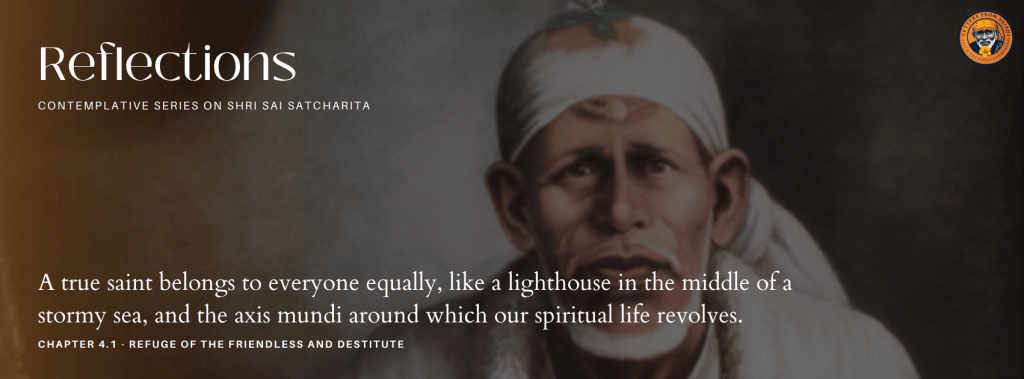
Saints, he says, are links between the human being and God. He describes them as courtiers at the court of God. When a sincere seeker approaches them with love, they create a bridge between the seeker and the Divine. Having remained and steadfast in Self-knowledge and experienced Self-realisation themselves since countless births leading to point of complete awakening, they can point others towards that same realisation as they are deeply attuned to what the seeker needs. And this is why he insists that the worth of a saint cannot be measured by worldly categories. Just as one cannot measure the circumference of the sky or fully assess the potency of a philosopher’s stone, it is futile to assign a caste or social identity to a saint. A true saint belongs to everyone equally, like a lighthouse in the middle of a stormy sea, and the axis mundi around which our spiritual life revolves. Coincidentally, a story from Kabir’s life appears in the Satcharita’s, Chapter 1 where Guru is likened to the handle of a wheel; holding on to which steadily, one will not be crushed like corn.
I could go on and on about the qualities of a true sage, from everything I have read and, in some measure, experienced, but I will voluntarily stop here. Because I do not need to look much further. If one simply reads about Baba, one begins to understand what a true saint, a true sage, an ascended master can be. I say this not as a devotee, but as someone who has spent years reading spiritual literature across traditions, only to find myself circling back to his teachings again and again. In everything I read or experience, I somehow find my way back to Baba. He is kindness personified. Despite our foolishness, resistance and countless ways of getting in our own way, He continues to forgive. His compassion is such that, at some point, you stop arguing with it. You begin to trust that He sees what you cannot, and knows what is best for you even when you do not.
A true saint, to me, is thus, one who ultimately takes you back to yourself. Slowly, almost imperceptibly, the disciple begins to become the master by dropping the very sense of separation between the two. And this is where grace becomes indispensable. There has to be a meeting, an inexplicable convergence of circumstances, where the threads of one’s fate meet the presence of a Guru at precisely the right moment. The Guru becomes the facilitator, the mirror, the hand that keeps appearing exactly when one needs it. The path is not easy. It was never meant to be. But when one has a Guru like Baba, the edges created by the illusion and duality begin to dissolve effortlessly, provided one has truly allowed oneself to be held. The identities, preferences, aversions, fears and certainties we so carefully construct begin to wither away. Eventually, even the distinction between “me” and “everything else” & grandiose version of oneself becomes less solid. What remains is a luminous no-thingness where nothing has been lost, yet everything is recognised as one. But before that, there is surrender. The unnerving, daunting, and herculean kind that asks us to trust His timing when we do not understand it, to trust His teachings when they challenge us, and to accept His hand even when He leads us towards things we would rather avoid. Shraddha and Saburi are disciplines of surrender, at least Baba’s devotees can never bypass. We have to keep choosing Him, again and again, especially when our own ‘human’ preferences tell us otherwise.
That is what Baba is here to give us. And I believe this is what all true saints do. They are like lights connected to a source we cannot perceive initially, tending to those entrusted to them and guiding them, often invisibly, towards the same light. They are lamps that light other lamps. What they receive in the abundance of love and wisdom does not remain contained within them. It passes through them, into the disciple, who then, without realising it, becomes another source of light for someone else. That in my humble opinion, is also how grace travels through the world.
Asto mā sadgamaya. Tamaso mā jyotirgamaya.
From the unreal, lead me to the Real.
From darkness, lead me to Light.
|| OM SAI SHRI SAI JAI JAI SAI ||
|| SHRI SATCHIDANANDA SADGURU SAINATH MAHARAJ KI JAI ||
Note: Since the chapters are long and stretch across many ovis, I will be breaking them down in a way that allows us to go deep without losing track. Each reflection will cover either a single concept, a leela, or at most 50 ovis – whichever completes a thought fully. This way, we can sit with every aspect of the Satcharita as carefully and reverently as possible, without skipping a single detail, guided always by Baba’s grace. I’ve also chosen this approach because very long posts can feel heavy or overwhelming for some devotees. Keeping them snack-able and focused will hopefully make it easier for everyone to read, return to, and reflect on in their own pace. All rights reserved.

 Letters From Shirdi
Leave a comment