
Note: I am referring the original Marathi Ovi version of the Shri Sai Satcharita, beautifully translated by Mrs. Indira Kher. No copyright infringement is intended. These reflections and interpretations are drawn from my personal experience, devotion, and evolving understanding of Baba’s teachings and unceasing grace. I fully respect that others may hold different views or insights, and I welcome the diversity of devotion. However, I retain the creative and devotional agency to express myself freely on this blog, which is a heartfelt offering to my One and Only, Satchidananda Sadguru Sainath Maharaj of Shirdi.
With Love, Priyanka
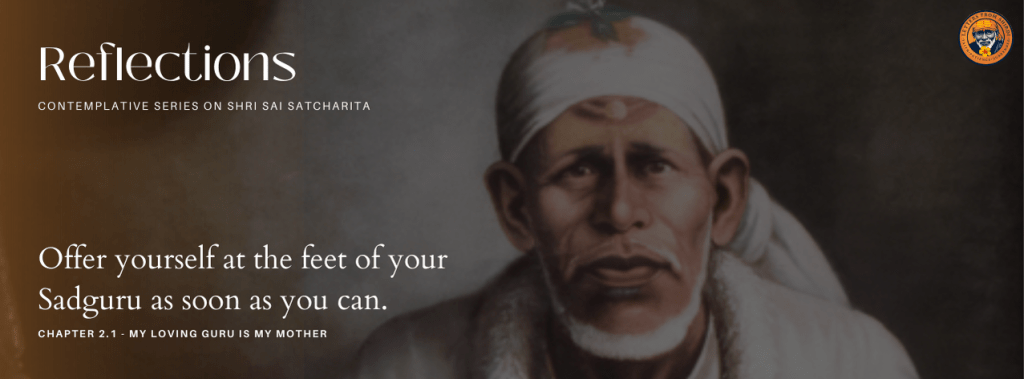
In Chapter 2, “The Purpose of the Book – Naming the Author,” the author explains in 198 ovis why he felt moved to write the Satcharita, who it is meant to serve and how, as well as how and why he was named Hemadpant by Baba. This is Part 1 of the reflection.
Life of a saint is a guide to the path of righteousness; it is neither Nyaya (epistemology) nor Tarkashastra (logic). Hence, to the one worthy of a saint’s grace nothing would be strange or surprising.
Ovi 7, Chapter 2, Sri Saisatcharita (Translated by Mrs.Indira Kher)
Many devotees of Baba or, in fact, seekers of any faith who have surrendered completely to their master, will recognise that when grace first touches us, something happens that the rational, linear mind cannot grasp. Miracles may unfold, but they are not “supernatural tricks.” They are the natural outcome of a heart lifted into a higher vibration simply by entering the living presence of the Guru or even under His wing after He has left the body as the Guru has already transcended all that is material while still moving in the world, and now functions as a direct extension of the Source itself.
In Baba’s case, He was not just a saint but a Perfect Master, The Absolute. Thousands of devotees across the world have been graced to this same living truth forming drops in the ocean of love that Baba is. When grace dawns for the first time, the ordinary mind goes into shock. We cannot understand what has happened, and yet we are overwhelmed with a joy so raw and undeniable that we cry, laugh, and want to shout from the rooftops about what we’ve experienced. Nothing in our lives before has ever compared. And beneath all the tears, laughter, and visible reactions, there remains an unshakable peace flowing silently within.
This was exactly the state of Shri Hemadpant. He was so moved and elevated by what he had witnessed in Baba’s presence that he felt compelled to write about it, despite being keenly aware of his own limitations, both mental and physical. His decision to write was not born out of pride, but out of awe, gratitude, and the irresistible force of Baba’s grace.
Rarest of the rare saints like Baba are a phenomena. They exist beyond the reach of rational understanding. No amount of intellect or ego can measure them. They can only be known through love. I am reminded of the saying, “A man has two lives, and the second begins when he realises he only has one.” In the spiritual sense, when Grace enters our lives, it is as though we are raised from the dead. The lenses of illusion, Maya, that once made the unreal appear real begin to fall away, and we start seeing things as they are. No external stimulus is needed; the love of the Guru is more potent than any intoxication. His presence alone dissolves the restless search for escape.
In my own life, I have felt this with Baba. When He enters, everything becomes about Him. His presence seeps into the smallest acts, eating, drinking, sleeping, working. What once felt mundane begins to feel infused with divinity. You find His images, symbolism, and stories everywhere. He will keep reassuring you that He is with you at all times, even before you ask for a reassurance. The Īsha Upanishad says, “Whatever exists in this changing universe is pervaded by the Lord.” And with Baba, this truth becomes a lived reality. He does not let you forget Him, provided you welcome Him with open arms, free from rationale, doubt, or hesitation, which are nothing more than projections of an ignorant conditioned mind that insists on seeing the world through its own narrow lens.
With Him, the ordinary becomes extraordinary. The unreal dissolves. And the only reality that remains is love. This is exactly what I believe Hemadpant ji must have experienced, just as so many of us have ever since Baba took us under His grace. He is the ever-radiant Source, shining with the light of a thousand suns, and I am nothing more than a speck of cosmic debris revolving around Him, not even as significant as a planet. Yet He graciously chooses to illuminate my heart, which has long been clouded by shadows of its own making – sadness, rage, malice, depression, insecurity, fear, and so much more.
The author humbly asks readers to come forward and share in his joy by listening to the stories of Baba. And truly, what can we ever offer to God, who is already Pūrṇa Parmātma, the complete and perfect One? Every ritual, offering, or act of devotion we perform is not for Him, but for ourselves, to keep reminding us of His presence and the reality that we are cared for. This reminds me of one of my most beloved vakhs by Lal Ded, the great Kashmiri mystic and embodiment of the Mother Goddess. She remains one of the women saints I hold most-most-most dearly. In I, Lalla, translated by Ranjit Hoskote, she says:
You are sky and earth,
day, wind-breath, night.
You are grain, sandal paste, flowers, water.
Substance of my offering, You who are all,
what shall I offer You?
Shravaṇ, or listening to the stories of the Divine, is itself one of the Navavidhā Bhakti (the nine forms of devotion) described in the scriptures, which Baba consistently urged his devotees to practice, especially in this Kaliyuga. To listen with the heart open is already an act of worship. It is also said that the Self reveals itself only to those whom it chooses. Anyone who can speak of God, think of Him, or listen to His name is already chosen in some way. Even when I encounter those who spread negativity in the name of God, asserting dominance or comparing belief systems, I remind myself that this too is within God’s will. They too are acting under the weight of their own karma, and perhaps God allows such behavior so that they remain bound in the cycle of saṃsāra until the time is right for their awakening.
For the devotee, the path remains simple: listen, remember, surrender, and love. And most importantly, focus only on your own path. When one encounters divinity, comes into contact with a saint, or sets foot on the path of awakening, the heart naturally turns toward renunciation, not always in the outer sense of giving everything up, but in the inner sense of loosening the chains of attachment. The goal becomes moksha, whether or not one is formally a renunciate. Often, sādhana does not give us what we want. Instead, it teaches us how to love without it. It strips us of co-dependency on people, jobs, relationships, or outcomes. Listening intently to the leelas of Baba gradually dissolves negative karma because we stop reacting in old patterns and start surrendering everything into His hands. Baba also teaches patience, especially in the sluggish periods of life when nothing seems to move forward. Never consider them punishments but lessons in faith, for what He ultimately seeks is our realisation.
Hemadpant ji confesses that he did not even know his own innermost relatives, so how could he possibly claim to know a saint? This is the essence, I feel, to know even one person fully, even our own Self, is to know all. But this is not an achievement of intellect or willpower. How can it be, since all these are marred by projections of ego? It is only the Guru’s grace that makes such realisation possible, until nothing remains but the awareness of pure being, not some hollow spiritual concepts, not illusions of who we think we are, who the Guru is, or what the Atman is. We can never capture God (who for me is Baba) in words but only live the experience, if He wills.
One may measure the volume of water of the seven great seas; the wide expanse of the sky may even be covered; but never can the saints be comprehended by the human mind.
Ovi 13, Chapter 2, Sri Saisatcharita (Translated by Mrs.Indira Kher)
Thus, every tale about Baba and every desire to speak of Him is itself His will. This blog, the countless books and articles written in His name, and every place where His name is taken, all of it flows only through His grace, His will, His doing. The Satcharita itself is nothing but our little boat, carrying us safely from choppy waters to still ones. We realise, slowly, that the longing to know the saint, the yearning for communion with Baba, and the impulse to share His stories are not separate from Him. They are His will moving through us. And perhaps, in the very act of narrating His stories, we begin to discover our own true selves, and in that discovery, find Him & thus, Oneness. Ramsukhdas ji often prayed: “Hey Nāth, main āpko bhoolūn nahī” (“O Lord, may I never forget You.”) For me, this prayer is a way of replacing every thought that is not Him. It is a way to anchor the day in remembrance, to build a routine that begins and ends in His presence. I have personally observed this in my own life. When I returned from Scotland, I exited the groups where I had been taking part in parayan, and soon after, I found myself easily triggered. My mental and physical health began to deteriorate, and I became gripped by fears of every kind.
It was only when I returned to reading the Satcharita and joined global parayan groups that my peace began to return. Even reading just two chapters every week brought me back to balance. That too, was Baba’s inspiration and guidance to affirm the efficacy of reading scriptures. These readings not only restored my calm but also helped me understand the nature of my own mind more deeply. And in that self-understanding, joy, peace, inner satisfaction, and true contentment arise. It is a contentment that does not waver, a sameness that stays no matter what comes and goes.
And when one is truly surrendered, one also realises that the Divine & reasons for His doing can never be completely known, as I mentioned before. Do you not sometimes wonder, what was the need for all this creation, this cycle of life and death, karma and rebirth? Yet this is not where the path of surrender leads. We do not waste ourselves in reasoning or questioning. We simply hand it all over, trusting that the Guru knows. He knows the past, present, and future. He even knows our past lives, and how the karmas we created ripened into prārabdha that shaped our families, our wounds, and our lessons, each one meant to be reminded, transcended, and dissolved. We may never fully know why, but Baba does. And it is our greatest fortune that we have Him to guide us through every step, in every breath, in every lifetime.
I am but the instrument moving mechanical, as Baba guides.
Ovi 44, Chapter 2, Sri Saisatcharita (Translated by Mrs.Indira Kher)
Many people still think that bhakti is something to be taken up in old age. I have often been told the same, “spare devotion for later.” But who said so? And who guarantees us old age? To think we will live forever is nothing but ego. The truth is, devotion must begin now. Offer yourself at the feet of your Sadguru as soon as you can. This very life has been given for the purpose of realising your true state, the ground of your being. Baba is always ready to bestow it, it is only our willingness that makes the difference. Listening to Baba’s leelas again and again builds faith. Faith deepens into patience and contentment, until the only desire that remains is the desire to hear more of His stories. We are all bound in the same saṃsāra, sharing solidarity in suffering, but when Baba becomes our naukhāhār, the boatman who ferries us across, there is truly nothing to worry about.
The most striking thing about Baba is that His words and actions are not contrived or borrowed. They flow directly from the vast well of realisation He was. Baba was the Source itself and knew everything. Whatever He shared with us was only a fraction of His knowledge, only what He considered necessary for our growth. Yet those very words continue to guide, protect, and transform us even a hundred years later. His devotees know, He still continues to do so in ways beyond our limited understanding, whether through dreams, intuition, other means and signs, or Sri Satcharita itself.
For that, I am deeply grateful to the author for mustering the courage, and to Shri Madhavrao Deshpande (Shama ji), who on his behalf placed the request before Baba to begin this great work. In becoming the instrument in Baba’s hands, Hemadpant ji gave us a treasure that continues to nourish us today.
In the next reflection, I will turn to how Baba permitted the writing of the Satcharita. If you are liking the reflections thus far, please share them far and wide.
Let us bring the self-same stories to the mind, again and again, and store up as many as we can, binding them together in the ties of love. The treasure can then be shared with each other, in profusion.
Ovi 61, Chapter 2, Sri Saisatcharita (Translated by Mrs.Indira Kher)
|| OM SAI SHRI SAI JAI JAI SAI ||
|| SHRI SATCHIDANANDA SADGURU SAINATH MAHARAJ KI JAI ||
Note: Since the chapters are long and stretch across many ovis, I will be breaking them down in a way that allows us to go deep without losing track. Each reflection will cover either a single concept, a leela, or at most 50 ovis – whichever completes a thought fully. This way, we can sit with every aspect of the Satcharita as carefully and reverently as possible, without skipping a single detail, guided always by Baba’s grace. I’ve also chosen this approach because very long posts can feel heavy or overwhelming for some devotees. Keeping them snack-able and focused will hopefully make it easier for everyone to read, return to, and reflect on in their own pace. All rights reserved.

 Letters From Shirdi
Leave a reply to 3.1 God Is enslaved by the love of His Devotees – Letters From Shirdi Cancel reply