
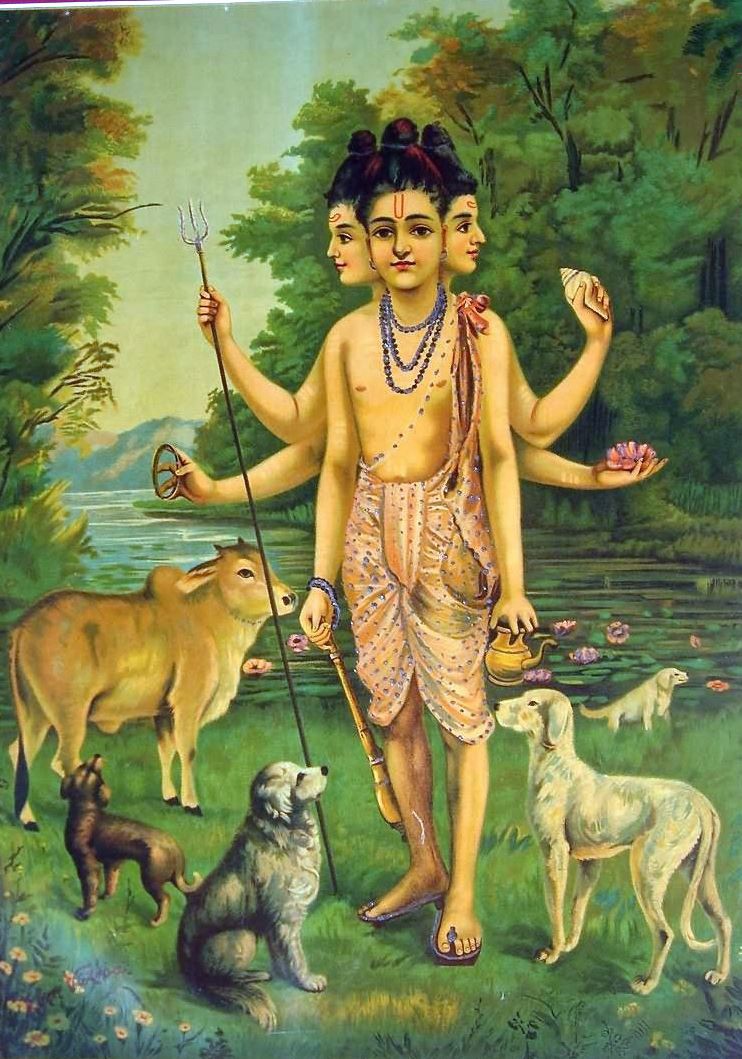
This will be a series of essays on the twenty-four teachers of Lord Dattātreya, the living mirrors drawn from earth, sky, creatures, and circumstance. Dattātreya, that ancient wandering sage with matted locks and three heads, bare-chested, carrying a begging bowl and staff, roams at once as ascetic and child, yogin and madman, the eternal avadhūta. His form itself is a symbol, three heads for Brahmā, Viṣṇu, and Śiva, creation, preservation, dissolution, held together in one body, the eternal witness. He wears nothing more than the directions, his home is the horizon, and his teaching can’t be given through lectures because whatever He uttered can only be experienced directly.
The story goes that when asked, “Who is your teacher?” Dattātreya replied: “The whole world has been my teacher. I have learned from earth and air, from fire and water, from creatures great and small. I have twenty-four gurus.” Each encounter was a scripture in itself. A python waiting, a pigeon clinging, a courtesan turning inward when all else failed. From each he drew a principle, a reflection, a way of seeing.
What Dattātreya called gurus, we today might call patterns of learning, living emblems that awaken something already within us. The modern word “archetype” which is my favourite can sound too clinical to some, too far from the soil so I’ll refrain from using it. The Bhāgavad Gītā offers another language for this, Krishna says, “Whatever is born of sattva, rajas, or tamas, know that it arises from Me alone. Yet I am beyond them.” (BG 7.12–13). In this sense, each of Dattātreya’s teachers is like a quality of nature (guna), a shape of the mind-heart, a mask the Self wears so that we might recognise ourselves. To study them is to look inward, to see how the moth burns in our own longing, how the sun steadies in our own center, how the spider spins the threads of our own world.
We are all of them, at once. The patient earth and the restless deer, the radiant sun and the weary courtesan, the solitary snake and the playful child. My method in these essays will be to approach each as an inner teacher, as a movement of psyche, body, and spirit that lives within all of us. By naming them, by seeing them, we begin to recognise the subtle cartography of our own becoming.
For me, this is not intellectual work but devotional, as everything else posted on this blog. Shri Sai Baba of Shirdi, my heart’s anchor, comes from this Dattā lineage. To reflect on these twenty-four teachers is, in some way, to sit closer to Him, to trace the roots of His silence and paradox, His laughter and compassion. It’s a privilege. It feels like spiritual inheritance, a chance to share what stirs in me when I walk beside these ancient mirrors or rather look within them, reflecting my own light.
Please note, this series is not a commentary. Each essay is just my understanding of Dattātreya’s twenty-four Gurus and how I’ve experienced them in my own life. If you contemplate closely, you may find your own teachers waiting, in the wind against your skin, in the hunger you resist or obey, in the quiet rhythm of your body itself. Every atom is a teacher if you are willing to be a student. I hope you like the series.
Gratitude only!
|| OM SAI SHRI SAI JAI JAI SAI ||
|| SHRI SATCHIDANANDA SADGURU SAINATH MAHARAJ KI JAI ||
 Letters From Shirdi