
With Love, Priyanka
To one, who sees only the Divine Spirit in the perceiver, the object of perception, and the act of perceiving, all are equal – a Brahmin or Pathan, or anyone else.
Ovi 141, Chapter 3, Sri Sai Satcharita (Translated by Mrs.Indira Kher)
In the previous reflection we discussed how everything is a manifestation of the Supreme Reality, no matter which name we call it by. When this is understood even partially, it becomes obvious that our small, separate self has no independent identity apart from that One. For us as devotees, that One is Baba, as the author rightly put. His mind was calm like a still lake, desire-less, detached, free from conceit, duality, and all traces of possession. The journey of the soul is nothing but a gradual shedding of the layers it has wrapped around itself over lifetimes, so it may return to its own unmoving, all-witnessing nature.
Hemadpant ji beautifully expresses that our individual consciousness is nothing but a tiny partake of His consciousness, which fills and pervades the entire universe. In that light, surrendering at His feet is the most complete service we can render as long as we are still identified with the body. And once that body-awareness withers, then truly there is no “we” and “Him” only One.
In Chapter 45, Madhavrao asserts how astonishingly easy it is, even in the darkest Kaliyuga, to attain liberation when one has a realised Guru like Shirdi Sai Baba. You become what you admire; you absorb the qualities of the deity you worship. And what better fortune is there for a soul than to begin recognising its own true nature, the very nature that Baba embodied so effortlessly, which reflected in every word He uttered and every action He took.
On another note, I often tell my mother to never underestimate her value as a devotee. A deity or Guru flowers in the world only because devotees remember, love, invoke, and keep their presence alive in the field of consciousness. Guru and devotee are mutually sustaining; they become each other’s prana. God cannot bear a second apart from the devotee who cannot breathe a moment without His name. Their relationship is indivisible, reciprocal, and continuous across lifetimes. We see this even historically. The Rigvedic gods once received thousands of hymns and were the living centre of spiritual imagination. But as collective remembrance shifted toward other deities, their felt presence in the devotional psyche receded. The gods didn’t go anywhere but the human attention moved. Where attention goes, prana flows; where prana flows, the deity becomes experientially alive.
This is not to say that atheists, agnostics, or non-theists are deprived of grace. Grace falls on everyone equally, effortlessly, all the time. It is the nature of the Absolute to shine without preference. The difference lies only in awareness, some turn towards it, others turn away, each according to their conditioning, wounds, and karmic trajectory. Here, however, we are exploring this in a gnostic, experiential sense – how remembrance, love, and surrender reshape the inner world and open access to the living presence of the divine. Indra, for example, to whom countless hymns are dedicated in the Vedas, is rarely invoked today except as a mythic figure. Worship shapes presence of the energy. Attention nourishes divinity in the human realm. Which is why, in these times, nāma-smaraṇa, the repetition of the divine name, has become the most reliable boat across this ocean of samsāra. Whoever your chosen deity or Guru is, their name becomes the rising sun that guides the soul home. So keep at it, with unwavering faith.
Across cultures, disciplines, and lineages there is a shared understanding that the individual mind is not isolated but embedded within a collective field. Jung called this the collective unconscious, the vast reservoir of archetypes and inherited psychic patterns that shape how entire societies think and behave. In anthropology this appears as egregores, thought-forms strengthened by collective emotional investment. In Tibetan Buddhism these are tulpas. In cognitive science, the same reality shows up as distributed cognition, the idea that mind is not limited to the skull but emerges through networks, environments, and shared symbolic systems.
All these frameworks point to one truth: concentrated human attention and emotion create energetic structures that acquire a momentum of their own.
Scholars usually discuss this in the context of how negative collective emotions – fear, hatred, shame – coagulate into heavy energetic fields that influence behaviour, anxiety, or mindless conformity. But since Baba teaches us to see reality as it is, without distortion from conditioning, it becomes important to explore the positive side of this phenomenon, which is rarely articulated. If emotional charge can empower negativity enough to form psychic fields or entities, then why can it not be consciously harnessed to empower divine energy? Why should we assume that the collective mind works only in the downward direction when its very structure is neutral? If thousands of people hold a deity in their heart with love, devotion, and surrender, the cumulative field becomes extraordinarily potent.
Anyone with even basic familiarity with quantum theories of observation, nonlocality, or coherence will recognise the principle – attention amplifies reality. This is why the power of a particular deity is palpably high around certain sacred places. It is not only the sanctity of the land; it is the density of devotion accumulated over centuries. Kedarnath vibrates with Lord Shiva’s presence, Tirupati with Lord Vishnu’s, Shirdi with Baba’s, Jammu with the power of Ma Vaishno Devi, Lourdes with Mother Mary, Pushkar with Lord Brahma’s, and scores of places across the world with their presiding divine energies. These places become energetic condensations of faith, hotspots, living reservoirs where the divine feels more accessible, more immediate, because countless minds have poured love, longing, prayer, and surrender into a single point.
…Between God and the saints, there is no separateness, as their incarnation on this earth is purely for the upliftment of both the animate and inanimate creations equally.
Ovi 149, Chapter 3, Sri Sai Satcharita (Translated by Mrs.Indira Kher)
That is the power of collective consciousness. Not imaginary, not exaggerated, not superstition. When enough hearts say “You are All,” the divine reveals it by becoming All in their lived experience. This is why in such places miracles happen with striking frequency. When thousands of minds hold a single deity in one-pointed remembrance, the collective field becomes charged with that very vibration, the deity’s presence becomes perceptible, and the invisible becomes almost tangible. I personally believe that if we are devoted to any form of the Divine for the sake of realising our true Self and attaining liberation, we must consider that energy as All. Every deity is a manifestation of the same Supreme Being, the Brahman. When we begin to see that One in everything and everyone, all differences dissolve, biases fall away, and it becomes easier to abide in the witnessing consciousness like the sun – steady, luminous, unreactive. We finally learn to see the rope as a rope and not mistake it for a snake born out of our own illusion. The only real practice is nāma-smaraṇa, continually reminding oneself of the principle of radiant sameness, the equanimity that comes from understanding that all pleasure and pain are movements of Prakriti, not indicators of divine reality.
In this light Baba’s instruction regarding the Rohila becomes beautifully clear. He asked everyone to leave the man alone and not complain about his loud cries for God because the man was soaked in ibādat, the same deep longing that in Hinduism is called bhakti. He was so immersed in remembrance that nothing else existed for him. Baba cherished nāma-smarana more than any amount of idle talk. He was a man of extraordinarily few words, as thousands of devotees apart from Hemadpant attest, but what mattered was how he used those words, never wasting a breath on anything that did not have God at the centre of his chintan. This is the example we are meant to follow: to keep returning again and again to the One reality that is untainted, unborn, undying, genderless, formless, attributeless, beginningless, endless, indivisible, unchanging, unconditioned, and all-pervasive. When this understanding stabilises even a little, the world no longer splinters into “this” and “that.”
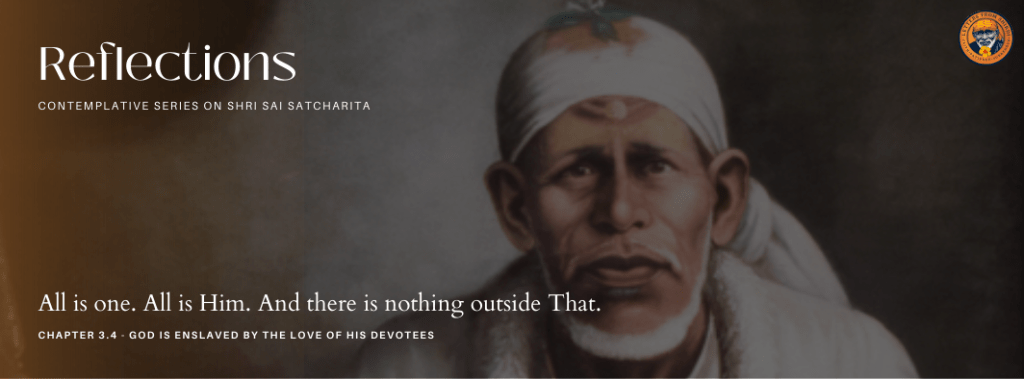
All is one. All is Him. And there is nothing outside That.
In the same incident, what Baba refers to as the “shrew, nagging wife” of the “madcap pauper” Rohila is not a literal woman at all. It is the exact same archetype we met in the reflection on Bhramarashtakam: lust, craving, desire, the inner Mara-daughter that clings, seduces, and refuses to let us exit the cycle of birth and death. This “wife” is māyic grasping. Even when driven out once, she returns through another doorway. Baba points that unless desire is subdued through nāma-smarana, we remain bound. Only remembrance cuts the knot.
And this is why, despite being foul-mouthed, volatile, and known for picking fights, Rohila was deeply loved by Baba. Day and night he remained absorbed in recitation, breath after breath synchronised with the divine name “Allah,” holding strict fidelity to his own path, as the author mentions. Constant remembrance had already begun purifying him – body, speech, and mind – exactly the transformation that Baba desires for every seeker. When someone holds that kind of unwavering focus, at the Guru’s feet, everyone around them begins to soak in the same vibration and dissolve karmic imprints. This is why group meditations, satsangs, and communal chanting exist. They drive away the mara-like impulses of craving, agitation, and distraction with the force of collective remembrance and oneness, passing into state of Unmana (transcending the three states of consciousness – waking, dreaming, deep sleep – and knowledge thereof).
So even though Rohila’s loud chanting was a headache to others, he was precious to Baba. He had conquered the inner shrew, the seductive pull of desire, not by suppression but through surrender. And Baba saw only that.
Baba spoke of His true nature thus after midday Aarti once:
“Wherever you are, whatever you do, always remember this one thing well, that I come to know, all the time and in detail, what you are doing. And I, about whom you have such an experience, am near to all and dwell in everybody’s heart……he who turns his attention to Me can have no difficulties whatsoever, but he who forgets Me will be ruthlessly whipped by Maya. This visible world is My own manifestation, be it a worm or an ant, a pauper or a king.” This immeasurable creation of the movable and immovable, is really Baba’s very Self.
Ovi 143-148, Chapter 3, Sri Sai Satcharita (Translated by Mrs.Indira Kher)
Hold on, dear one, Hold on to divine name and never leave the side of your Guru for that is the only way out of this samsāric wheel.
|| OM SAI SHRI SAI JAI JAI SAI ||
|| SHRI SATCHIDANANDA SADGURU SAINATH MAHARAJ KI JAI ||
Note: Since the chapters are long and stretch across many ovis, I will be breaking them down in a way that allows us to go deep without losing track. Each reflection will cover either a single concept, a leela, or at most 50 ovis – whichever completes a thought fully. This way, we can sit with every aspect of the Satcharita as carefully and reverently as possible, without skipping a single detail, guided always by Baba’s grace. I’ve also chosen this approach because very long posts can feel heavy or overwhelming for some devotees. Keeping them snack-able and focused will hopefully make it easier for everyone to read, return to, and reflect on in their own pace. All rights reserved.
 Letters From Shirdi
Leave a comment