
With Love, Priyanka
Note: I am referring the original Marathi Ovi version of the Shri Sai Satcharita, beautifully translated by Mrs. Indira Kher. No copyright infringement is intended. These reflections and interpretations are drawn from my personal experience, devotion, and evolving understanding of Baba’s teachings and unceasing grace. I fully respect that others may hold different views or insights, and I welcome the diversity of devotion. However, I retain the creative and devotional agency to express myself freely on this blog, which is a heartfelt offering to my One and Only, Satchidananda Sadguru Sainath Maharaj of Shirdi.
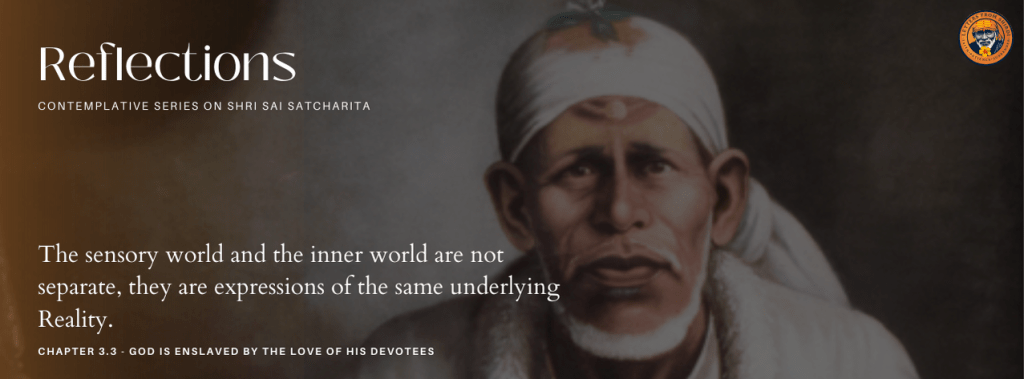
In these few ovis from Chapter 3, Baba offers a profound exposition on the Ātman, revealing Himself as the Absolute incarnate, as Nisargadatta Maharaj rightly called Him many years later. He wasn’t just a man, few cubits in length, but Parabrahman itself.
I am not the gross form with the mind, intellect, and other sense organs, nor the gigantic universe. Nor am I the unmanifest Brahmanda. I am the Seer, ancient and without beginning.
Ovi 91, Chapter 3, Sri Sai Satcharita (Translated by Mrs.Indira Kher)
As I read and reflect on these words, I often find myself slipping into an inner stillness, something close to samādhi, tasting the exact state of oneness Baba points to or so I believe. I recommend reading this chapter after every couple of days. In the Ribhu Gita, the Upanishads, and many other Vedantic texts, it is said that a jīvanmukta is one for whom everything is included within the Self. And if everything is within you, what can possibly exist outside of you? If all of it is a part of you, how can anything be apart from you? When this truth is glimpsed, understood and rather lived, all biases begin to dissolve. Choices lose their grip, differences, perceptions, and even emotions and thoughts gradually lose their authority. One no longer reacts from fragmentation or separateness.
Baba reassures His devotees while revealing His true nature. He pervades the universe in all directions through Aṣṭadhā Prakṛti, the eightfold nature: earth, water, fire, air, ether, mind (the field of emotional afflictions), reason (the discerning faculty of understanding), and egoism (not arrogance, but the consciousness of individual existence), the radical predicament of “being.” To the first five gross elements are attached their subtle counterparts, the pañca sūkṣma bhūtas: gandha (smell) to earth, rasa (taste) to water, rūpa (form or sight) to fire, sparśa (touch) to air, and śabda (sound or speech) to ether. Through this, Baba shows that the sensory world and the inner world are not separate, they are expressions of the same underlying Reality.
Only where there is a realisation that the intellect, mind, and other sense organs are but gross instruments of the physical body, true detachment will appear, unveiling real knowledge. Oblivion of the Self is itself the appearance of Maya or illusion that the world is real. Realisation of the Pure Bliss within is to know me, the Essence of all being.
Ovi 93-94, Chapter 3, Sri Sai Satcharita (Translated by Mrs.Indira Kher)
I will not go into the full philosophical context here, but in the Chandogya Upanishad (Chapter 7), these very elements are explained as manifestations of Brahman itself. The Upanishad repeatedly leads the seeker from the gross to the subtle, from name and form to essence, culminating in the great declaration “Sarvaṁ khalvidaṁ Brahma”, all this is indeed Brahman. Whether it is food, breath, mind, speech, or space itself, each is shown to be a pathway to the same Absolute that Baba embodies and teaches through His silence (and His words).
For me, this is a profound lesson in non-doership and in seeing the entire world as a reflection of God. God cannot be defined. God can only be pointed to through sat–chit–ananda. These same three principles appear in the world as jnana–ichha–kriya and as sattva–rajas–tamas. What we call the “world” is nothing but these divine qualities expressing themselves everywhere. The problem is not the world, but the mind, which becomes so absorbed in forms that it misses the essence behind them. Brahman is the object, subject, cause, and the result.
God cannot be defined, not because language is weak, but because definition itself requires limitation. To define something is to place boundaries around it, to say what it is and what it is not. The Supreme, by its very nature, is limitless, omnipresent, and all-encompassing. That which is everywhere cannot be located. That which is everything cannot be contrasted. The mind works by comparison and division, so it cannot grasp the Absolute as an object of knowledge.
We usually assume the world to be solid and primary, and God, if we acknowledge God at all, to be distant or abstract. Baba reverses this completely. God is primary. The world is secondary. The world has no independent reality of its own; it acts like a mirror through which the nature of the Supreme becomes visible.
The sages use three words to point toward this Reality: sat, chit, and ananda. These do not describe God as an object or an old man in the sky. They point to the basic nature of existence itself. Sat means absolute existence. Not existence opposed to non-existence, but that which never ceases to be. Everything in the universe changes. Bodies age, thoughts arise and fade, emotions come and go. Yet there is a constant sense of “is-ness” that remains through all change. That ever-present being is what sat refers to. Chit, or chitta in its functional sense, means consciousness. Not personal thinking or mental activity, but awareness itself. Every experience appears within this field of knowing. The mind does not create awareness; the mind appears within it. He is pointing to the shift from individual mind to pure consciousness. Ananda is not pleasure or excitement. It is the fullness of being, the absence of inner lack. When fear withers away and craving ceases, what remains is causeless contentment. This peace is not produced by circumstances. It is revealed when ALL resistance drops.
These three are not separate qualities. They are three ways of seeing one indivisible reality. What exists is conscious, and what is conscious is whole. And only whole is holy. Baba says, once this wholeness is realised, what remains to be desired?
Worldly desires are of various types. But once the significance of ‘who I am’ is understood, they melt away as the hailstones by the heat of the sun’s rays.
Ovi 90, Chapter 3, Sri Sai Satcharita (Translated by Mrs.Indira Kher)
His key insight is that these qualities are not confined to a distant spiritual realm. They appear everywhere in daily life. When sat–chit–ananda move into manifestation, they function as jnana shakti (the power of knowing), ichha shakti (the power of willing), and kriya shakti (the power of action). Knowing, desiring, and acting are not human traits separate from God. They are divine energies operating through human form.
The same truth appears again as the three gunas. Sattva expresses clarity and harmony. Rajas expresses movement and activity. Tamas expresses inertia and obscuration. Every object, thought, and emotion contains these three in different proportions. Baba is showing the same reality through different lenses. Seen this way, the world is not separate from God. When something exists, we are seeing sat. When we know anything, we are participating in chit. When we seek fulfillment or feel drawn toward something, we are touching ananda, even if in a distorted form. The world is God’s nature appearing as multiplicity.
Why do we not see this clearly? Baba says the mind is confused. He has transcended all, one without beginning or end. But as we have a conditioned mind, it clings to form: names, identities, stories, judgments. These are not false, but they are surface-level. When attention stays trapped in form, essence is overlooked. We see the wave and miss the ocean. The world reflects not only God, but also the condition of the mind. A restless mind sees a restless world. Projections and unresolved patterns are experienced as external reality. This does not mean the world is unreal. It means perception is shaped by the state of the chitta.
This is why purification of the mind is so important for clarity of perception. As the mind becomes quieter and less driven by fear and desire, the same world begins to appear more coherent and harmonious. Nothing outside has changed. The mirror has simply been cleaned. To say the world is a mirror of Baba does not deny suffering or limitation. It just, I believe, places them at the level of form and manifestation, not at the level of essence. Beneath agitation is existence. Beneath confusion is awareness. Beneath longing is fullness.
In any experience, one can ask: does this exist? Is it known? Does it draw its meaning from a deeper sense of wholeness? When these questions are lived rather than merely thought about, the world slowly reveals itself not as an obstacle to God, but as a continuous reflection of the Divine. And when this recognition stabilises, the mirror is no longer mistaken for the source. The reflection is enjoyed without confusion, and attention rests naturally in that which neither appears nor disappears: sat, chit, ananda, whole, silent, and self-luminous.
To such a one then, as me, when all the workings of the mind, all affections are turned, that is the true service and true worship to me. To experience the bliss of consciousness, is to be in that pure state which is knowledge.
Ovi 95, Chapter 3, Sri Sai Satcharita (Translated by Mrs.Indira Kher)
Just the fact that Baba encourages His devotees to realise the Self speaks volumes about Him as a Master. He does not create mere followers; He creates masters. His only concern is Realisation, not worldly immortality, but the salvation of His devotees. And once one is fully devoted, Baba becomes everything on the journey. He becomes the boat, the ocean, the oar, and the ferryman, until the moment dawns when we realise that we are none other than Him. If He is All, how can we be separate from Him? And if we are not separate, how can He not know our innermost being? How can He not already hold the remedies for all our problems and afflictions, the answers we keep searching for? He is aware of everything that moves within us and around us. And how could we ever be cut off from Him, even for a moment, when He is present in every breath we take? Baba is never far. We only forget to notice.
When the river gives herself up to the ocean, can she ever come back again (as river)? Can she retain her separate identity as a river, once she has embraced the vast ocean. An oil-soaked cotton wick, as she meets the flame from the lamp, herself requires greater brilliance and burns brighter. Such is also our progression at the feet of saints.
Ovi 99-100, Chapter 3, Sri Sai Satcharita (Translated by Mrs.Indira Kher)
|| OM SAI SHRI SAI JAI JAI SAI ||
|| SHRI SATCHIDANANDA SADGURU SAINATH MAHARAJ KI JAI ||
Note: Since the chapters are long and stretch across many ovis, I will be breaking them down in a way that allows us to go deep without losing track. Each reflection will cover either a single concept, a leela, or at most 50 ovis – whichever completes a thought fully. This way, we can sit with every aspect of the Satcharita as carefully and reverently as possible, without skipping a single detail, guided always by Baba’s grace. I’ve also chosen this approach because very long posts can feel heavy or overwhelming for some devotees. Keeping them snack-able and focused will hopefully make it easier for everyone to read, return to, and reflect on in their own pace. All rights reserved.
Sources referred for this post (other than Sri Satcharita): The Principal Upanishads by S. Radhakrishnan, Teachings of Baba Hari Dass, The Ribhu Gita


 Letters From Shirdi
Leave a comment