
Note: I am referring the original Marathi Ovi version of the Shri Sai Satcharita, beautifully translated by Mrs. Indira Kher. No copyright infringement is intended. These reflections and interpretations are drawn from my personal experience, devotion, and evolving understanding of Baba’s teachings and unceasing grace. I fully respect that others may hold different views or insights, and I welcome the diversity of devotion. However, I retain the creative and devotional agency to express myself freely on this blog, which is a heartfelt offering to my One and Only, Satchidananda Sadguru Sainath Maharaj of Shirdi.
With Love, Priyanka
The part of chapter 3 under consideration for this reflection is so moving that it will be less of a musing and more of a summary and assertion of author’s words, I believe. After deciding to trust Baba’s words despite his initial hesitation and feelings of incapability, Hemadpant ji writes of the marvel of the Guru’s grace, that even on a stiff, dry tree, flowers bloom and fruits ripen abundantly without water; that the dumb begin to speak like Brihaspati, and the lame cross Mount Meru. That is the power of true faith, to believe that the Guru’s words are law. Even when all odds are against us, His grace fulfils every promise.
And yet, if fear or doubt overtakes us, we risk the greatest sin, disobedience to the Guru. So the author began to write, or rather, Baba wrote through him. Baba took the pen from his hands, subdued his ego, and composed His own Charita. Through this act, He blessed Hemadpant ji with a direct experience of akartṛtva (non-doership) and humility. We are blind when it comes to Brahma-jñāna until the Guru’s grace opens our divine sight and cuts through illusion. But when Baba Himself is our staff, there is no need for distress. Just lean on Him. Place all hopes in Him. The other day, I read that when one is not attached to creating something but simply does what the heart asks, whether in art, writing, or service, that is when something original, living, and timeless emerges. This is exactly how Hemadpant ji surrendered his task: without even an iota of ego. If I were in his place, I might still have a subtle awareness, not of arrogance but of identity, the thought that “I am the one Baba has chosen as His medium.”
There is a subtle yet profound difference between awareness and arrogance. Awareness still contains a trace of “I-ness,” a self-observer who feels chosen, whereas arrogance inflates this “I” into ownership and pride. Awareness can mature into surrender but arrogance resists it. The goal, therefore, is not even to retain awareness of being the medium but to dissolve entirely in the flow of the Divine Will. And since this truth is now visible to me, I pray to Baba to dissolve even this faint self-awareness, to grant me egolessness and perpetual access to His true, absolute nature. May we all reach samata, equanimity, become witnesses to all that happens, and know that in our essence, we are one with Baba.
The author humbly admits that concepts like Advaita, Karma, Dharma, Brahman, Yoga, Sādhanā, Dhyāna, and Dhāraṇā are difficult for ordinary minds to grasp and I agree. One must first cultivate oneness with the deity through saguṇa bhakti (devotion to the embodied form of the Divine) before moving to nirguṇa (formless) realisation. He reminds us that, in this Yuga, the simplest and surest path to salvation, open to all, regardless of caste or creed is śravaṇ (listening), manana (reflection), and kīrtana (joyful repetition) of the Divine Leelas. Through them, duality dissolves, worldly attachments loosen, and desires lose their hold.
Yet, no one can hear these stories unless God wills it, unless one has the merit (puṇya) accumulated over lifetimes. He illustrates this truth beautifully through a metaphor I keep repeating in my conversations,“A cow will not let her milk flow without her calf, even when her udders painfully overflow.” To me, this speaks of pātratā, worthiness or vessel-hood if that’s a word. Only when God deems us ready, when our inner vessel is large enough and deserving, does He pour the milk of spiritual grace. Sravaṇ(hearing), manana (contemplation), chintana (reflection), and śaraṇāgati (surrender). Such blessings are always fruits of past lives’ karma. It is the Guru who rejoices most in the spiritual progress of the disciple even when that progress comes through hardship. For only when the disciple matures can the Guru’s true purpose be fulfilled – liberation from saṃsāra.
Later in the chapter, when Chinchinikar ji asks Baba to secure more pension for Hemadpant ji, as his family was growing and retirement neared, Baba replies that he would get some service, but that he should now engage in “My service.” To a mind caught in worldly worries, this may sound strange but Baba knew better. He reminds us that there will never be a dearth of food, clothing, or shelter in the life of a true devotee. So when desires rise, recall that these are the only three necessities of life. Everything beyond that is a want and perhaps even greed. It is our responsibility as devotees to keep our desires in check. All that is expected from a devotee is utmost faith, discernment, and detachment from non-virtuous people, places, and influences, not with superiority or contempt, but with reverence for Guru’s word and spiritual clarity. Right conduct and the path of dharma are what make one a divine vessel, capable of receiving the Guru’s unceasing grace.
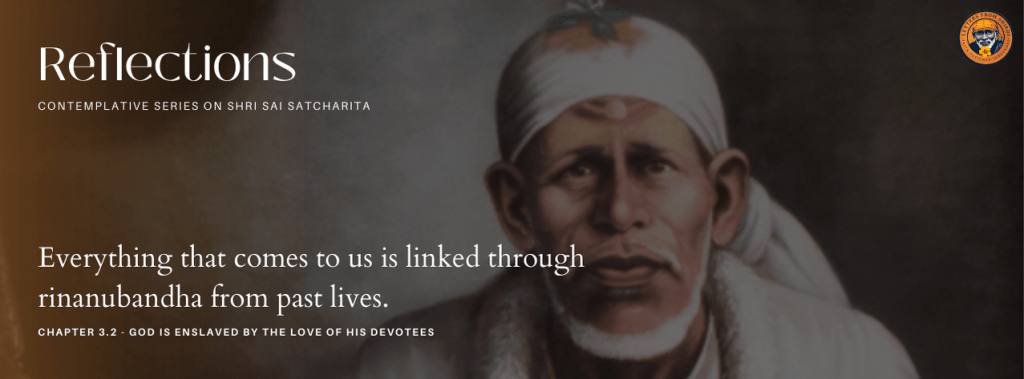
Lastly, when it comes to rejection or contempt, Baba specifically instructed His devotees never to repulse or reject any being, whether human or non-human, including animals, insects, or even subtle entities. Everything that comes to us is linked through rinanubandha from past lives. Even the mosquito that bites you comes because of karmic debt. The same is true for the people we meet, and even for spirits or unseen beings. All originate from the same Divine Source, all are part of the same Consciousness. Shiva embraces ghosts, ghouls, ganas, humans, and animals alike because He is Nāth to everyone, and called Pashupatinātha, Lord of all beings. With my own experiences, I’ve realised that our repulsion towards others is often a deeper lack of acceptance toward ourselves. When we study the Buddhist samsaric wheel or the Hindu descriptions of ancestral, hell, godly, and animal realms, we understand that the soul passes through countless states to exhaust karmic residues. If we ourselves could have been any of these beings in past lives, how can we reject them now?
Just seek Baba’s love, protection and guidance.
Though Baba gave examples of animals here, I took the liberty of extending it because the principle is the same and His words are never exclusive since we all are His children. To explain it simply, animals are bound by their nature. They do not have the kind of self-reflective mind that can choose between virtue and vice, so their lives unfold primarily to release karmic debts. They do not accumulate new karma because they have no sense of doership. A snake will hiss and bite; a scorpion will sting. It is their nature. It is our karma and responsibility to be aware of their presence and avoid harm. Beyond that, all is Baba’s will. Similarly, most discord in human relationships arises because we cannot accept another’s nature. We want to fix, reform, or control them. But nature (svabhāva) is deep-rooted. Just as you cannot scold a scorpion for stinging, you cannot force someone to be what they are not. All you can do is create distance where needed, prevent situations that bring disharmony and pain, and maintain compassion without entanglement.
This is discernment, not pure rejection out of malice, ill-will or superiority, and it is entirely aligned with dharma.
|| OM SAI SHRI SAI JAI JAI SAI ||
|| SHRI SATCHIDANANDA SADGURU SAINATH MAHARAJ KI JAI ||
Note: Since the chapters are long and stretch across many ovis, I will be breaking them down in a way that allows us to go deep without losing track. Each reflection will cover either a single concept, a leela, or at most 50 ovis – whichever completes a thought fully. This way, we can sit with every aspect of the Satcharita as carefully and reverently as possible, without skipping a single detail, guided always by Baba’s grace. I’ve also chosen this approach because very long posts can feel heavy or overwhelming for some devotees. Keeping them snack-able and focused will hopefully make it easier for everyone to read, return to, and reflect on in their own pace. All rights reserved.
 Letters From Shirdi
Leave a comment