
Note: I am referring the original Marathi Ovi version of the Shri Sai Satcharita, beautifully translated by Mrs. Indira Kher. No copyright infringement is intended. These reflections and interpretations are drawn from my personal experience, devotion, and evolving understanding of Baba’s teachings and unceasing grace. I fully respect that others may hold different views or insights, and I welcome the diversity of devotion. However, I retain the creative and devotional agency to express myself freely on this blog, which is a heartfelt offering to my One and Only, Satchidananda Sadguru Sainath Maharaj of Shirdi.
With Love, Priyanka
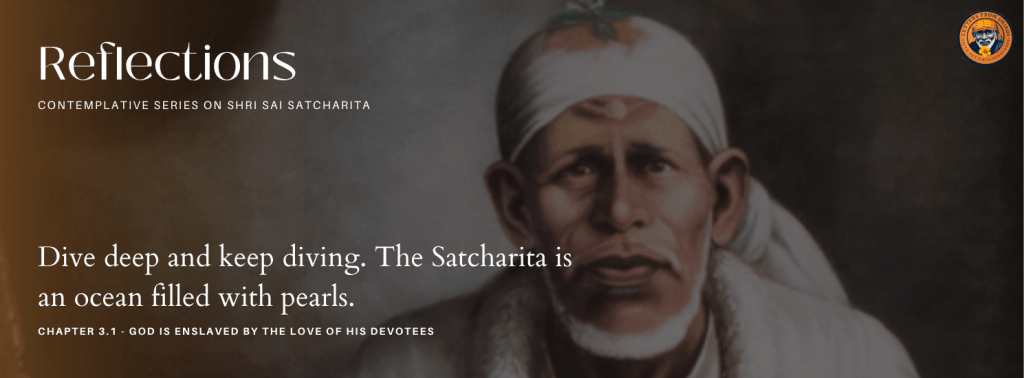
In Chapter 3, “The Purpose of the Book – Baba’s Approbation of His Gatha,” the author narrates in 185 ovis how he received Baba’s permission to write the Satcharita and how the author was accepted as a scribe in Baba’s durbar. Here, Baba not only approved the writing of His biography, but declared that He would write it with His own hands. Hemadpant ji then exalts Baba in his usual heartfelt manner, offering metaphor after metaphor, each one a beacon for devotees like us. Personally, these metaphors have been anchor points for me during phases when life feels heavy or when Baba’s presence seems silent. They remind me again and again that His grace is perennial, even when unseen. This is Part 1 of the reflection.
“You do your own part well; have not the least hesitation in your mind. Trust my words fully and make a firm resolve in the mind.”
Ovi 2, Chapter 3, Sri Sai Satcharita (Translated by Mrs.Indira Kher)
As a writer, I can understand how the author must have felt cold feet before taking up such a monumental work. He must have battled self-doubt and moments of self-sabotaging thoughts as elaborated in ovi after ovi. Be honest with yourself and think of how many times you have held back from something your heart urged you to do, simply because you thought you were incapable, or someone else would do it better, or you would fail. All of us know this feeling. Over the past nine years, it took multiple scoldings from Baba for me to finally trust myself. Even now, as I write this, there are projects I conceived a year/s ago which I haven’t begun. I plan and plan and outline endlessly, instead of doing the work, because doing demands consistency and self-trust. Whether it is improving oneself or achieving a goal, only effort can move us forward. And when Baba Himself gives us assurance, what is there to fear?
He got some devotees to build temples; some others, He got deeply interested in doing kirtans. Some He sent on pilgrimages; but as for me, He bade me write. Of them all, I am the lowliest. By virtue of which quality in me, this Sai, this ocean of Kindness and Mercy was so pleased with me, I failed to understand.
Ovi 22-23, Chapter 3, Sri Sai Satcharita (Translated by Mrs.Indira Kher)
If you are reading this, remind yourself of Baba’s words in this chapter. Think of Him seated in your heart, giving you the confidence to trust yourself, give your best, and surrender the rest to His feet.
This is exactly what the Mahabharata teaches. Perform the action with sincerity, and let God handle everything else. Baba tells Hemadpant ji that writing His leelas will dissolve sins committed out of ignorance. This word is important. It means, when you knowingly go against dharma, you incur karma but actions done out of unawareness, where the consequences were not understood, fade away through remembrance, surrender, and righteous effort. And in Shirdi Sai Baba’s case with recording, discussing, and sharing His divine leelas becomes a tool of liberation. Karma grows only when we perform and repeat actions driven by desire. Desire is the petrol that keeps the engine of samsara running. But when actions are done as dharma, with right intent and purity of heart, they bring no ill effects even if, outwardly, the results seem harsh or unpleasant.
Arjuna never fought the war. It was Krishna acting through him, because every arrow he released was for upholding righteousness. So next time you cut off a relationship that is harming your mental or spiritual well-being, stop engaging with someone who drains your peace, choose to walk away from an argument instead of feeding ego on either side, decide not to respond to a disrespectful message, say no where you previously said yes out of fear or guilt, do not feel guilty if your intent is right. Place it in Baba’s feet. Hold no grudges, no anger, only clarity and compassion for all including yourself. Be the observer. Anything that obstructs your spiritual progress should be renounced like poison. That is not “bad karma.” When done without malice, ego, or desire, and offered to the Guru, such actions become purifying rather than binding.
These leelas that Hemadpant ji describes are not mere stories or attempts as assuring anything or proving points (something which was strictly warned against by Baba). Baba says they remove the cares and burdens of worldly life and awaken love and devotion. When a devotee listens to them again and again, like diving repeatedly into a sacred ocean, gems of wisdom rise into their hands. I have seen this myself. Every leela in the Satcharita teaches me something new each time I read or listen. Even a single line becomes hours of meditation, especially Baba’s own utterances. When you encounter such divine incidents, you realise how useless the things are that we keep our minds occupied with, arguments, overthinking, food, obsessing over clothes, anxiously chasing achievements, comparing ourselves with others, coveting what they have, clinging to status, reputation, possessions, or the desire to “become” something. The Upanishads say: whatever you take from the world during life is exactly what the world will take back from you at death. We forget life is finite. We keep saying, “I will meditate tomorrow, I will pray tomorrow, I will practice dharma tomorrow.” But who guarantees tomorrow?
See every sunrise and sunset with awareness, because one day, they will be your last. And there is no better time to devote yourself at Baba’s feet than right now. In Buddhism, which I also practice, meditation on death is essential, it keeps the practitioner steadfast on the path of liberation. Padampa Sangye, a great Tibetan master, said in The Hundred Verses of Advice just before passing:
“If you waste the present moment meaninglessly and depart with empty hands, people of Tingri, a human life will be very hard to find again.”
A perfect human birth is rare. A perfect birth with favourable circumstances, spiritual inclination, and, above all, a Guru like Baba makes it even more precious. There is no time to squander. Dive deep and keep diving. The Satcharita is an ocean filled with pearls. So my dear reader, dive without fear.
Dubkiyāṅ sindhu meṅ gotākhōr lagātā hai,
Harivansh Rai Bacchan
The diver plunges again and again into the ocean,
Jā jā kar khālī hāth lauṭkar ātā hai.
and often returns empty-handed.
Milte nahīṅ sahaj hī motī gahirē pānī meṅ,
Pearls are not found easily in deep waters,
Baṛhtā dugnā utsāh isī hairānī meṅ.
yet his enthusiasm only grows in this mystery.
Muṭṭhī uski khālī har bār nahīṅ hotī,
For no hand remains empty forever,
Kośiś karne wāloṅ kī kabhī hār nahīṅ hotī.
and those who keep trying are never defeated.
I had never read a scripture in my life until recently. For years, I relied solely on the Satcharita for guidance. Now, even when I read far more complex scriptures, their meanings reveal themselves instantly because I can connect every idea back to something Baba taught through experiences in my life and these leelas. Such is the kind of writing Baba gifted us through Hemadpant ji. I recommend you pick one scripture, just one, and drink it fully. Absorb it. Digest it. Let it become part of your being. Once your consciousness opens through one text, all others will begin revealing their truth. The author also notes that many scholars knew scriptures “in letter but not in spirit,” and so tried to speak about God and prove their points without ever tasting Him.
Sri Hari (God) is the sport of his own devotee that is, He dances to their tune, hungry for simple and the guileless, and enslaved, altogether, by love. But to the hypocrites, He remains unattainable, always.
Ovi 9, Chapter 3, Sri Sai Satcharita (Translated by Mrs.Indira Kher)
All doubts dissolve for one who approaches spiritual path with sincerity. Hemadpant ji calls himself a labourer at Baba’s service. That is the attitude we must cultivate. Baba is our mother, father, brother, spouse, Guru, and Master. And we are His dās, a lesson we must learn from Lord Hanuman’s love for Sri Ram, the simplest antidote to arrogance. May we never forget this. When I worked in the corporate world, I used to tell Baba, half jokingly, “You are my boss, and also my assistant.” And as Baba always does, He proved Himself to be both.
“He who gives himself up to me with single-minded devotion and sings my praises with full faith, remembers me and contemplates on me, the deliverance of him is my promise.“
Ovi 15, Chapter 3, Sri Sai Satcharita (Translated by Mrs.Indira Kher)
Before I end this reflection, a gentle reminder, in His words, kirtan, śravaṇ, and manana of Baba’s leelas are the highest way to generate merit for Hid devotees. Listening with love, reflecting with sincerity, and contemplating with devotion, only in this lies our welfare. Only in this lies the fulfilment of Baba’s descent upon earth. This was His constant concern. Because Baba was a mahasiddha, He chose to descend in human form solely to liberate and uplift all who came to Him, across past, present, and future. Imagine the magnitude of selflessness and karuṇā required for such a vow.
As addressed to Shama ji, He grants the wishes of those who chant His name with love, devotion, and faith. Such a devotee will always feel Baba standing before them, behind them, and all around them. The delight that arises from listening to these stories is natural, and through them one attains perfect, unstained happiness, peace, and contentment. Baba promises that mere listening to His leelas cures disease, saves the devotee from the jaws of death, brings deep satisfaction, and helps the mind and ego transcend their limitations. The chitta becomes a mass of divine energy. Even the simple repetition of “Sai, Sai” burns sins born of dark desires of Kaliyug. Mere prostration at His feet destroys the sins accumulated through speech and hearing.
And I, like countless devotees across time and space, have witnessed Baba uphold His promise, again and again.
What could be attained by meditation in the Krita or Satyayuga, by performing sacrifices in the Tretayuga, by ritualistic puja in the Dwaparyuga, can all be attained in this Kaliyuga by praising the name of God and by worshipping the guru.
Ovi 27, Chapter 3, Sri Sai Satcharita (Translated by Mrs.Indira Kher)
|| OM SAI SHRI SAI JAI JAI SAI ||
|| SHRI SATCHIDANANDA SADGURU SAINATH MAHARAJ KI JAI ||
Note: Since the chapters are long and stretch across many ovis, I will be breaking them down in a way that allows us to go deep without losing track. Each reflection will cover either a single concept, a leela, or at most 50 ovis – whichever completes a thought fully. This way, we can sit with every aspect of the Satcharita as carefully and reverently as possible, without skipping a single detail, guided always by Baba’s grace. I’ve also chosen this approach because very long posts can feel heavy or overwhelming for some devotees. Keeping them snack-able and focused will hopefully make it easier for everyone to read, return to, and reflect on in their own pace. All rights reserved.
 Letters From Shirdi
Leave a comment