
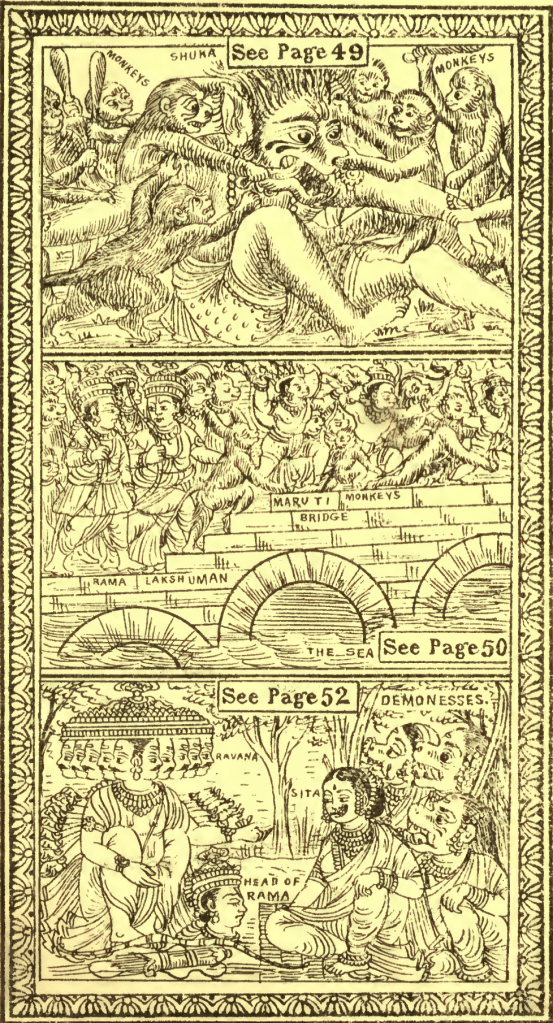
Rama set Shuka at liberty, who went to Ravana and informed him of what had happened — how the bridge had been built across the sea. He earnestly advised the demon-king to submit to Rama and restore Sita to him.
Ravana grew indignant and said, “You are alarmed because they beat you! If you advise me that way again, I shall cut off your head at once.”
Soon after, Ravana sent two demons, Shuka and Sarana, to Suvela to ascertain the position of Rama’s army. The two demons took the forms of monkeys and mingled with the troops of the prince.
Vibhishan informed Rama that the demons had entered the camp disguised as monkeys to gather intelligence. Whereupon Rama ordered his monkeys to let them count the army freely. The two demons were accordingly taken around the entire encampment. Having seen its vastness, they returned to Lanka and said to Ravana, “Rama has a great army of monkeys. It will be very difficult to defeat him. We therefore implore you to submit to him and restore Sita.”
Ravana was enraged and threatened to cut off their heads if they advised him again. He then went up to the top of his tower with the two demons to see Rama’s army for himself.
Vibhishan came and informed the prince that the demon-king was on his tower observing their forces. At that moment, Sugriva leapt from Suvela — though it was hundreds of miles from Lanka — and, reaching the tower, snatched the mukut(crown) from one of Ravana’s heads before returning swiftly to camp.
The demon-king was alarmed and descended at once in confusion.
A few days later, he said to his courtiers, “I have no patience left. I must marry Sita at once. If anyone among you can make her love me and consent to marry me, I shall be forever grateful.”
His minister, Vidyujiva, who was well-versed in magic and sorcery, replied, “I shall, by means of sorcery, create a head identical to that of Rama, along with his dhanushaban (bow and arrow), and show them to Sita. Seeing them, she will believe that her husband is dead. Then, hopeless and broken, she may yield to you.”
“I am very thankful to you for your excellent scheme,” said Ravana. “There is no doubt you will succeed in it.”
Vidyujiva accordingly created the illusory head of Rama and his bow and arrow. Ravana then went to the Asoka forest and said to Sita, “I am very sorry to inform you that your beloved husband is dead, and his brother Lakshman has fled to Ayodhya. Maruti, Sugriva, Nala, Nila, Angada, and all other warriors are also killed. You are alone here — helpless. I therefore beseech you to marry me. You shall be my first queen, and Mandodari will be your maid-servant.
“Alas, Sita! Rama is no more. Believe me — and if you doubt my word, here is the head of your Rama, cut off by a demon, and here is his bow and arrow.”
As soon as Sita beheld the head and the bow, she fainted. In deep grief, she said, “Ravana, I look upon you as my father. I implore you to order a pyre of wood to be arranged, that I may set fire to it and burn myself. I do not wish to live any longer.”
Hearing these words, Ravana returned to his court, leaving her alone.
In the meantime, Sharmā, the wife of Vibhishan, came to the Asoka forest and informed Sita that Rama was well and that the head shown to her had been created by sorcery to make her lose hope and yield to Ravana.
No sooner had Sharma spoken these words than the illusory head and bow disappeared.
Soon after, Ravana said to his wife Mandodari, “You are my faithful wife and love me much. I have a great passion for Sita, and if you do not help me, I shall die. If you truly love me, go to Sita and persuade her to marry me.”
Mandodari went to the Asoka forest and conveyed her husband’s wishes to Sita, then returned home.
She said to her husband, “Dearest, Sita is not a woman who will comply with your wishes. She is a paragon of virtue. She would rather die than yield to your passion. There is no use in pursuing her. I beseech you to restore her to Rama. Why do you covet another man’s wife?”
“My love,” replied Ravana, “what you say is true. But I shall never submit to Rama and humiliate myself before all nations. I shall fight him and die, but I shall never restore Sita.”
Having failed to persuade her husband, Mandodari returned to her palace.
Ravana again went up his tower with his courtiers to view Rama’s army. Rama, too, climbed a hill with Sugriva and his companions to see Ravana and his ministers.
While Ravana was observing the army, Sugriva leapt from the hill and struck down the mukuts (crowns) from his ten heads. The demon-king, astonished, fought with the monkey; but Sugriva, delivering heavy blows, escaped and returned to Rama with joy. Ravana, filled with alarm and shame, descended again.
After all preparations for war were complete on both sides, Vibhishan said to Rama, “Before attacking Ravana, it is wise to attempt negotiation. Send an ambassador to his court and request him once more to restore Sita.”
Rama accordingly sent Angada to Ravana’s court. But none paid attention to him there.
The monkey grew angry and said to the demon-king, “Ravana, do you know who I am?”
“Who are you, and what is your name?” asked Ravana, scornfully.
“I am a servant of Rama,” replied Angada, “and my name is Angada, son of Vali. I have come to negotiate peace. Restore Sita to Rama and end this conflict.”
“I shall never make peace with Rama,” said Ravana.
“I tell you once more,” said Angada, “restore Sita and save yourself. If you refuse, you will lose your life and all of Lanka. Rama is powerful — you cannot prevail against him.”
“You are a shameless creature,” retorted Ravana. “Rama killed your father, and instead of avenging him, you now serve his killer!”
“No doubt, Rama killed my father,” said Angada calmly, “but by that arrow he ascended to heaven, where he now enjoys eternal bliss.”
Furious, Ravana ordered four demons to bind Angada. The demons seized him by the arms, but the monkey struck Ravana on the chest with his tail, leapt up, and carried away his mukuts, chatra, and mandap before returning to Suvela.
The four demons clung to his shoulders, hanging head downward, and were killed by the fall to the ground. Until next time, Jai Shree Ram!
|| OM SAI SHRI SAI JAI JAI SAI ||
|| SHRI SATCHIDANANDA SADGURU SAINATH MAHARAJ KI JAI ||
Note(s): This narration is based on Ramavijaya: The Mythological History of Rama (Bombay, 1891, Dubhashi & Co.), a public domain text shared here for free reading.
This section is faithful to Ramavijaya’s folk-Marathi variant of Yuddha Kanda, but with elaborations not in Valmiki: The magical illusion of Sri Rama’s head appears in several later Puranic and regional Ramayanas (esp. Adbhuta Ramayana, Ananda Ramayana) and Sharma (Vibhishan’s wife) is a local addition — her name varies (sometimes Trijata or Sarama in Tamil and north Indian versions).
 Letters From Shirdi
Leave a comment