
From there, he went to the palace of Vibhishan, the youngest brother of Ravana, where he was much pleased because the demon was a devotee of Rama, and everything there was clean. He also saw an idol of Rama, Vishnu, which Vibhishan worshipped every day.
Thence he went to the palace of Kumbhakarna, who was in deep sleep, snoring all the time. Maruti was disgusted with the heaps of bones and the flesh of human beings and animals scattered around his palace. When he failed to find Sita there and at other places, he was enraged; and, assuming an invisible form, he began to trouble the demons and demonesses of Lanka in various ways.
When they carried water in their pots, he broke them with his tail. He dashed to pieces the chariots of the princes who happened to drive in the streets. One day a barber began to shave the beard of Ravana, when Maruti stood behind him in an invisible form and thrust his tail into the hose of the former. The barber was startled, and in confusion he shaved off the mustaches of Ravana.
Ravana got angry and slapped the barber in the face, when the monkey also gave a slap to the demon-king. Maruti pulled down the houses of the demons with his tail while their families were asleep. One day, in a minute, he extinguished all the lamps in Lanka, and consequently, all of a sudden, the city was in confusion and alarm.
The inhabitants of Lanka said to themselves, “Sita, whom Ravana has brought here, has created this devil to annoy and trouble us.”
Maruti then entered the palace of Ravana, where he and his wife, Mandodari, were fast asleep. On beholding Mandodari, Maruti thought that she was Sita and that she had fallen in love with the demon-king. He grew very angry and was about to carry them to where Rama was staying with Lakshman. But, in the meantime, Mandodari awoke in alarm and said to her husband, “I have dreamt a dream which indicates that Indrajit and you will be killed, that the Asoka forest will be destroyed, and that Lanka will be burnt, because you have unjustly brought Sita here. I therefore implore you to restore her to her husband.”
“You need not be afraid of that in the least,” replied Ravana. “I have posted five crores of demons and demonesses to watch the Asoka forest, and they will not allow Rama to kill us or destroy the forest.” So saying, Ravana despatched his servant to the Asoka forest to see whether Sita was there.
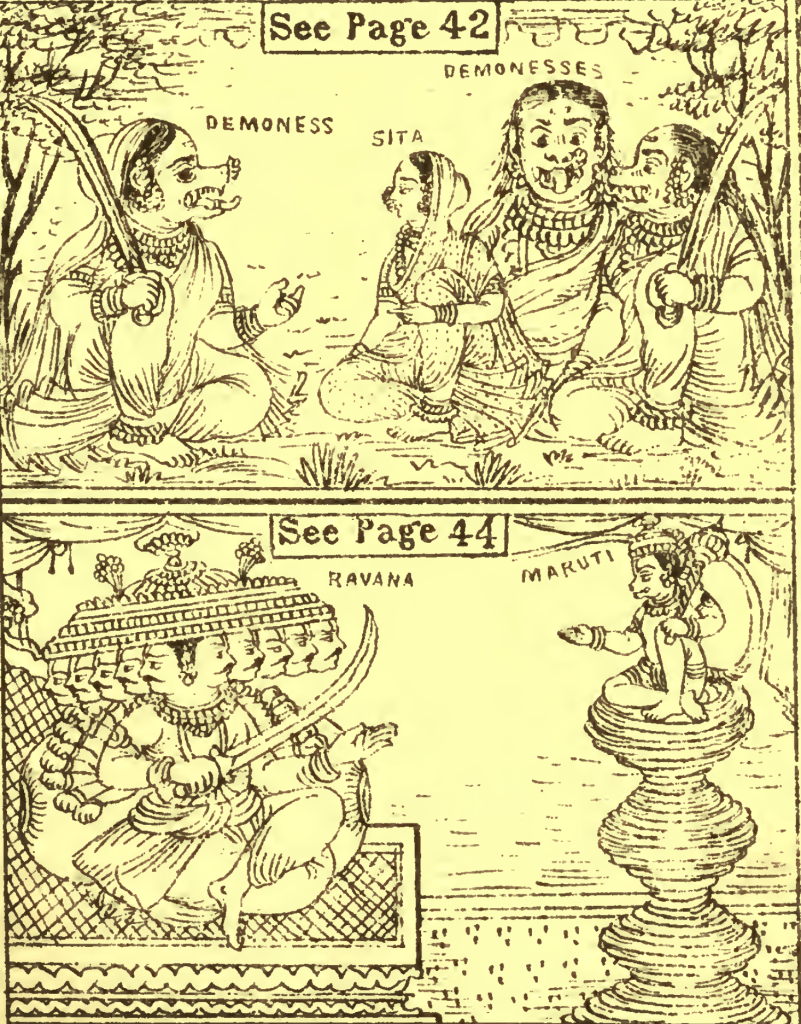
Maruti accompanied the servant in an invisible form. He saw Sita sitting under the shade of a tree. The servant returned to Ravana, and Maruti remained in the Asoka forest.
The monkey was exceedingly glad when he found Sita, and threw before her the ring which Rama had put on his finger. She looked at the ring and asked, with tears in her eyes, “Ring? Where have you come from? How is my Rama? Is he safe?”
While Sita was asking about the ring, the demonesses came there and told her to keep quiet, saying that if she did not listen to them, they would devour her. Then Maruti, with his tail, tied all of them together and flung them down. Some of them died and some fled.
He then began to sing, and his voice was so pleasing to her ears that she became very anxious to see who that creature was. She called several times, but nobody responded. Disappointed, she prepared herself to commit suicide, when the monkey came and stood before her.
She asked him, “Who are you? What is your name, and where have you come from?”
“I am a servant of Rama and have come here in search of you,” replied Maruti. “Your Rama is well and has come to Kishkindha for you. He will shortly take you from this place. You need not be afraid of me. I am not a demon. I am the son of the wind, and my name is Maruti.”
“Besides that ring,” continued Sita, “have you got any other proof from Rama that you are his servant?”
Whereupon he recounted all the calamities that had befallen her, and she was thereby convinced that he was indeed her husband’s messenger.
“I should have annihilated Lanka in a moment and taken you to Kishkindha,” said Maruti, “but Rama did not order me to do so. I am very hungry. Will you therefore allow me to take fruits from the trees in the forest for my breakfast?”
“It is not in my power to allow you to take fruits from this place,” replied Sita, “and if you forcibly take them, the demons and demonesses will kill you. However, I tell you to gather for your breakfast the fruits that have fallen on the ground and not to take them from the trees with your hands or feet.”
“I swear that I shall not take any fruits from the trees with my hands or feet,” said Maruti. “I shall take the fruits which have fallen on the ground.”
So saying, he lengthened his tail and plucked all the fruits with it; and after a few minutes, he destroyed the whole of the Asoka forest.
The sixty crores of demons who were watching the forest at once came upon him, but he tied them up with his tail and flung them down. Some died and some fled. Hearing this news, Ravana sent eight thousand demons to catch the monkey, but the latter tied them up with his tail and killed them all.
Ravana was greatly enraged and sent one lakh warriors, whom the monkey threw into the sea with his tail. The demon-king then sent his son, Akshaya, with a large army; but he too was killed along with his companions. Immediately after, Ravana despatched a frightful demoness called Asali, who had the strength of ten thousand elephants. She opened her hideous mouth one yojan in length and breadth and devoured the monkey, but he tore her belly open and came out.
At last Ravana sent his son, Indrajit, with a large army of demons. He let off his arrows at Maruti, which the latter broke off with his hands in no time. The monkey pulled off his mangal sutra with his tail, broke his chariot, and killed his horse. He took up an iron bar and went on killing the demons with it, when Indrajit attempted to catch him in a snare. But the monkey became as small as an atom and escaped every time the prince put it upon him.
Whereupon Indrajit made a snare with a smaller noose and put it upon him, when Maruti assumed a large form and broke the snare. When the prince failed to catch him, he fought with the monkey, but the latter flung him to the ground. The prince was alarmed and said to himself that if he was seized by the monkey and carried to Rama, he would be cruelly treated. So saying, he hid himself in a cave, when Maruti blocked up the mouth of it with a mountain. Indrajit cried and wept. Until next time, Jai Shree Ram!
|| OM SAI SHRI SAI JAI JAI SAI ||
|| SHRI SATCHIDANANDA SADGURU SAINATH MAHARAJ KI JAI ||
Note(s): This narration is based on Ramavijaya: The Mythological History of Rama (Bombay, 1891, Dubhashi & Co.), a public domain text shared here for free reading.
The sequence of Hanuman’s mischief, his meeting with Sita, and the destruction of the Asoka grove are generally faithful to Valmiki’s Ramayana (Sundara Kanda), but Ramavijaya adds hyperbolic folklore elements (e.g., 60 crore demons, slap to Ravana, and barber episode) typical of Marathi oral tradition.
The “Asali demoness” does not appear in classical Sanskrit versions; she’s a folk addition representing the tamasic(dark) force of egoic pride tested by Hanuman’s divine intelligence.
In Valmiki Ramayana, Indrajit does indeed subdue Hanuman using the Brahmastra, here it’s adapted into the “snare and cave” allegory, showing restraint through wit, not divine intervention.
Hanuman’s refusal to act beyond Rama’s command is theologically significant in Bhakti traditions, demonstrating dasa bhava (servant-devotion) and self-restraint even when capable of destruction.
 Letters From Shirdi
Leave a comment