
Sita all the time cried aloud the name of Rama, which Jatayu, a huge eagle, heard and went to her rescue.
“Ravana,” said Jatayu, “I command you to set Sita at liberty; and if you disobey me, I shall instantly kill you.”
“Who art thou?” replied Ravana. “What hast thou to do with this lady? Thou fool, go and mind thy business.”
Jatayu insisted, and Ravana let off arrows at him. The bird cut off with his bill all the arrows of the demon-king, broke the head of his charioteer, and killed his horses. Ravana alighted, when the bird pounced upon him and pulled off his hair. He was alarmed and stood there bewildered, not knowing what to do. The bird broke his chariot, when the demon-king said, “Speak the truth. Just tell me how you will die. I shall also tell you how I shall die.*”
Jatayu, who was simple-hearted, replied, “If you pull off my wings, I shall die instantly.”
“Now just tell me,” continued Jatayu, “how you will die.”
“If you break my toes,” said Ravana, “I shall die in no time.”
As soon as this secret was disclosed by Jatayu, Ravana went to catch him. The bird broke one of the toes of his enemy, when the latter pulled off his wings.
Jatayu, saturated with blood, fell there rolling; and the demon-king, taking Sita on his shoulders, proceeded towards Lanka. When he reached the hills called Matang, five powerful monkeys — Sugriva, Nala, Nila, Jambuvant, and Maruti — who lived there, found the ornaments thrown by Sita on the ground.
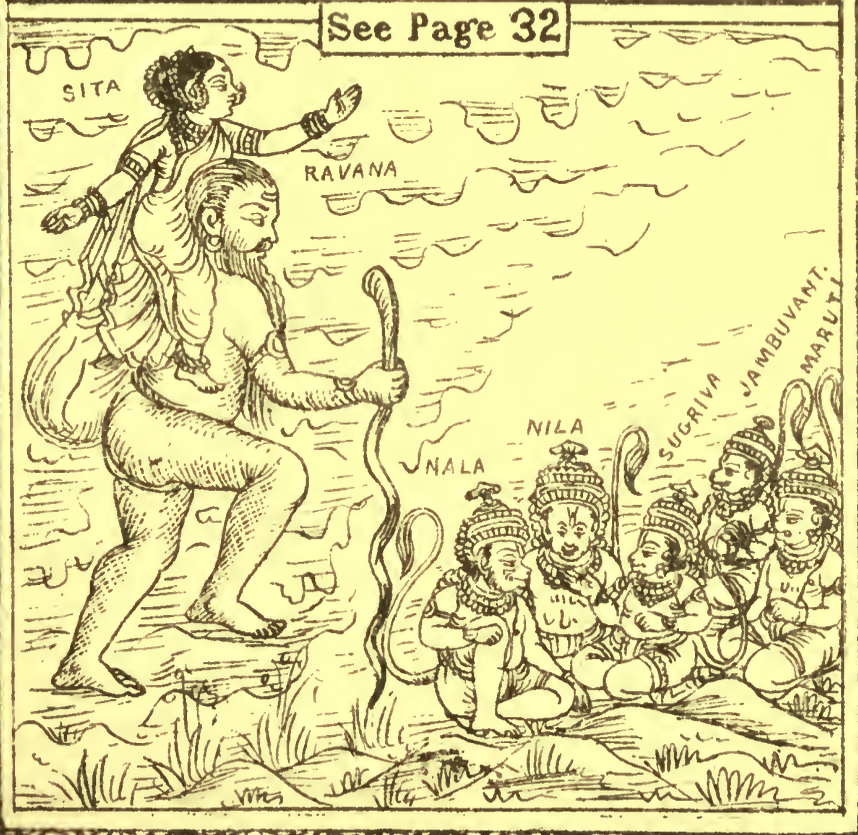
Looking at the ornaments, Maruti said, “Pity, some wicked demon must have been carrying off a poor woman. I shall kill the demon and rescue her.” So saying, he jumped into the sky; but in the meantime, Ravana entered Lanka with his prize and despatched eighteen huge demons to search and kill Rama.
A few days after his return to Lanka, the demon-king said to Sita, “I beseech you to marry me. I am very powerful and have made all the gods my slaves. There is not a single soul on earth who can equal me in wealth, strength, and valour. If you be my wife, you will be very happy.”
“Thou art wicked and a villain,” replied Sita. “Thou wilt soon die. I shall never be thy wife. I loathe thee. Begone, thou fool.”
Having heard these words of Sita, Ravana said to himself, “Sita is very much excited; and unless she becomes calm, I shall not be able to win her heart.” So saying to himself, he placed her in the Asoka forest and posted five crores of demonesses with his sister Trijata as their head to watch her there, with instructions to frighten her and make her marry him at any rate.
The demonesses often showed their teeth and opened their hideous mouths as if they were going to devour her, but Sita was calm and did not heed them. Trijata, who was kind, encouraged her and told her not to frighten herself.
Lakshman joined Rama in the forest and informed him of what had passed between Sita and himself. Lakshman wept, and Rama pacified him. They then returned to Panchavati; and finding that Sita was not in the parnakutika, they were alarmed and went in search of her.
They could not find her. They then went to the Rishi Agastya, who informed them that Sita was carried off by Ravana. They returned to their abode and saw the footprints of the demon and Sita. They immediately set out in search of Sita in the forest.
On the road they met Jatayu, who informed them of what had happened. “I,” said Jatayu, “mustered up all my strength and courage to rescue her from the wicked demon, but as soon as he cunningly knew my secret, he pulled off my wings and left me here in a dying state.” So saying, Jatayu breathed his last. Rama grieved for him and performed the funeral ceremony of his death. The princes proceeded on their journey.
On the road, Parvati*, the wife of Shiva, took the form of Sita and stood before him; but he did not receive her, as he knew that she was Parvati.
A little further on, a huge demon called Kabandha, stretching his arms for some eighteen yojanas and with his head separated from his trunk, sat in the forest. Rama, having found that he was a demon, cut off his arms and killed the monster on the spot.
Kabandha was the son of Kashyapa, a Rishi. One day he got drunk and frightened another Rishi, Stulashira, who cursed him, saying that he would be a demon but that he would be released from the curse when Rama would kill him.
As soon as he was killed by Rama, he assumed his original form and stood before him. He said that his head was separated by Indra from his body with his vajra, a thunder weapon, as he was performing a severe penance to enable him to take the kingdom of the god.
On the road, Rama killed the eighteen demons whom Ravana had sent and came to the Pampa Sarovar, a river, where Rama and Lakshman sat down for rest under the shade of a banyan tree.
From the hills called Rishimukha, the five monkeys saw them. Sugriva was afraid and said, “I think Vali, my brother, has sent those two warriors to kill me.” So saying, he was about to flee when Maruti said, “Do not be afraid. I will ascertain who those warriors are.”
So saying, Maruti jumped upon the tree and, having plucked off its branches, threw them at Rama. Rama cut them off with his dhanushabans. Maruti then threw large stones and mountains at him, but he broke them in a minute and hurt the monkey in the air.
His father, the wind, supported him while he was falling down and bade him worship Rama. He came down and, having thrown himself at the feet of the prince, implored his pardon, which was readily granted by him.
He became a great devotee of Rama; and one day, while he was shampooing the feet of the prince, he said to him, “I shall be very glad to introduce you to Sugriva, brother of the king of this place, if you promise me that you will protect him.”
“Just tell me who that Sugriva is,” replied Rama. Whereupon Maruti related the story of the life of Sugriva, which will be shared in the next chapter. Until next time, Jai Shree Ram!
|| OM SAI SHRI SAI JAI JAI SAI ||
|| SHRI SATCHIDANANDA SADGURU SAINATH MAHARAJ KI JAI ||
Note: This narration is based on Ramavijaya: The Mythological History of Rama (Bombay, 1891, Dubhashi & Co.), a public domain text shared here for free reading.
*The Ramavijaya version of Jatayu’s battle adds the “exchange of death secrets” motif (toes and wings), which is not in Valmiki Ramayana but appears in some folk and Bhavartha-based retellings in Maharashtra and Bengal.
*The presence of Parvati appearing as Sita is also unique to regional versions, not part of the classical epic.
 Letters From Shirdi
Leave a comment