
Rama and his brothers, now young princes, begin their training and soon, the world will witness Rama’s first great battles, a sage’s curse lifted, and the breaking of Shiva’s mighty bow.
After nine months Kausalya, Sumitra and Kayakayi were delivered of sons. They grew up, and the ceremonies of investing them with sacred threads were performed. They were taught by Vashista the Vedas, sacred writings of the Hindus, and mantras.
On his return from a pilgrimage, Viswamitra, a Rishi, came to Ayodya. Dasharatha received him cordially and worshipped him with devotion. The Rishi blessed him and said to him, “Dasharatha, I want you to give me a promise, incantations, that you will give me whatever I will ask from you.” The king gave him the promise the Rishi required, when the latter said to the former, “We all the Rishis are very much troubled by the demons, Maricha, Subhahu, and others. They have often destroyed our havans, and consequently we are not able to perform our yagna, a sacrifice, successfully. No one can kill them except Rama. I therefore, wish you to send Rama with me to kill the demons.”
Dasharatha was startled and replied, “Rishi, how can I send my tender child with you? How can he kill the mountain-like demons? You may ask me for any other thing but not Rama.”
Vishwamitra became very indignant and said, “You ought to have considered well, before you gave me the promise. At any rate I must now take Rama with me.” In the meantime Vashishta came there and advised the king to send Rama with the Rishi, saying that if he did not listen to him, he would curse him and his sons, as he was obstinate and of a choleric disposition. Dasharatha then brought Rama and Lakshman before his sabha and gave them in charge of the Rishi.
Vishwamitra then, accompanied by two young boys, set out for the forest, where the Rishis were performing their yagna. But on the road they were encountered by Tataki, a hideous and frightful demoness. She had the strength of ten thousand elephants, her chest was as large as a mountain, her hair and dress were saturated with blood, the strings of dead-bodies were put round her neck, and her head was besmeared with shindur, red powders. As soon as she saw them, she opened her mouth and went with other demonesses to devour them, when Rama instantly killed her with one arrow.
Twenty crores, ten millions, of demons, headed by Banasur, a very powerful demon, then came upon Rama to revenge the killing of the demoness, but they all were repulsed by him with heavy loss. After the defeat of the demons they proceeded on their journey; and when they came near a shila, a flat stone, it began to tremble as soon as the dust from the feet of Rama fell upon it; and no sooner did he touch it with his feet, then it became a beautiful woman, who, bowing to Rama, returned to her husband.
Bramhadev had a very beautiful daughter, named Ahilya. Many Gods and kings requested her father to give her away in marriage to them. But Bramhadev had made a condition that whoever would go round the earth and return within six hours should marry her without loss of time. Whereupon all the kings and Gods, including Indra, went round the earth, but none could return within six hours except Gowtam, a Rishi, to whom Ahilya was married agreeably to the condition.
Indra became very jealous of the Rishi and sought to outrage her modesty. Some time after his marriage, he and his wife went to a river with Rishis for ablutions on the day of an eclipse. After their ablutions were over, Gowtam sat there with other Rishis for meditation, and his wife returned home. While she was alone in her abode, Indra went there in the form of her husband and outraged her modesty. In the meantime, Gowtam returned home; and finding Indra in the abode he cursed him and Ahilya, saying that there would be one thousand ulcers on the body of the God and that his wife would be a shila and remain in that state for sixty thousand years, but that as there was no fault on her part, she would be released from the curse when Rama would touch her with his feet.
Ahilya accordingly became a shila and Indra, a peacock with one thousand ulcers on his body. While the God in the form of a peacock was flying about in forests, the other Gods prayed to Gowtam for him, who, having been pleased with them, restored Indra to his former state and turned all the ulcers on his body into eyes.
After the release of Ahilya from the curse, Vishwamitra proceeded on his journey with Rama and Lakshman. Shatanand, a son of Ahilya and the priest of the king Janak, also accompanied him. They all arrived at the City of Mithila and put up at a garden there. At the request of Rama, Vishwamitra related the story of the birth of Sita, a daughter of Janak, which is as follows:
“There was a king called Padamaksha. One day he said to Lakshmi, wife of Vishnu, I wish you would be born in my family and become my daughter. She replied, If I be born in your family and I become your daughter, you will be miserable. I have, however, no objection to become your daughter, if my husband tells me to do so. Whereupon the king performed a severe penance to gain the favour of Vishnu, who was pleased with him and gave him a fruit, which the king took at home and kept with him. After nine months were over, the fruit bore a female child, the same Lakshmi.
The king, having got a daughter, became exceedingly glad and named the child Padmakshi. She grew up and became marriageable. Many kings, demi-gods and Rishis requested her father to give her away in marriage to them, but he refused to comply with their request, saying that he would marry her to a man whose body was dark blue. At this refusal, they all got enraged and killed the king on the spot. Whereupon his daughter threw herself into a havan in which the consecrated fire was burning. At that time, Ravan happened to look at her, and was captivated with her charms. He immediately extinguished the fire with a view to catch her, but she disappeared.
He found in the havan five ratnas, precious stones, gems, which he gave to his wife, Mandodari. The five ratnas were placed by Ravana and his wife in a box and soon after, they found, to their great surprise, that a female child played in it with pleasure. Ravana lifted the child, but Mandodari said, “If you keep this child here, the whole of Lanka will be set on fire. The kingdom of Padmaksha was annihilated on account of this child, and the poor king was killed by the kings and demi-gods, who had gone there to marry her. I, therefore, propose that the box should be thrown somewhere else.”
Ravana was alarmed, and ordered his minister to bury the box in the kingdom of Janak, who was the bitterest enemy of the demon-king. The minister accordingly ordered his men to carry the box and bury it as directed by Ravana. The men lifted up the box, when the child said, “I shall again come here and extirpate all the demons.” Ravana got enraged and was about to kill the child, when Mandodari prevented him from doing so.
The box was then carried at night and buried in the field presented by Janak to a Brahmin. One day while the Brahmin was ploughing his field, he found the box and carried it to the king. The box was opened and, to the great astonishment of all, a girl of the age of five years was found in it. As soon as the king saw her, he was moved with affection and brought her up as his daughter.
One day Parashuram, having killed all the Kshatriyas, warriors, on earth, came to the kingdom of Janak. He went into the palace with the king to take dinner; and when he came out after dinner, he found that someone had removed the dhanusha, bow, placed by him at the court of the king. He was greatly enraged and said, “Who has taken my dhanusha! It is so heavy that it cannot be removed even by thousands of elephants.” So saying he came out of the court with the king to look for it but, to his great surprise, he saw the girl riding on it. No sooner did she behold her father than she left the dhanusha there and ran away.
Seeing this, Parashuram said to the king, “My incarnation is now over. Let the dhanusha be here. I now advise you to hold a swayamvar, the choosing from amongst a public assembly of a spouse by a female, and marry your daughter to any man who will lift up the bow and break it off.” So saying Parashuram left for his abode. Soon after, the king held a swayamvar and invited to it all the kings and rishis on earth. We too are going there only, concluded Viswamitra.
All attended the swayamvar including Ravana, who came there without invitation. The king told the assembly that Sita would be married to any man who would lift up the dhanusha and break it off. Many kings attempted to lift it up, but they all failed in their attempt.
Ravana then stepped forward and loudly said with pride and vanity, “This bow is a trifling thing to me. I shall break it off in a second. I know, ye weak kings and Rishis, will not be able to lift it up. It is I who would lift up the dhanusha and break it off. Sita will be my wife, and I shall be her husband.” So saying, he began to lift up the dhanusha with all his strength and force.
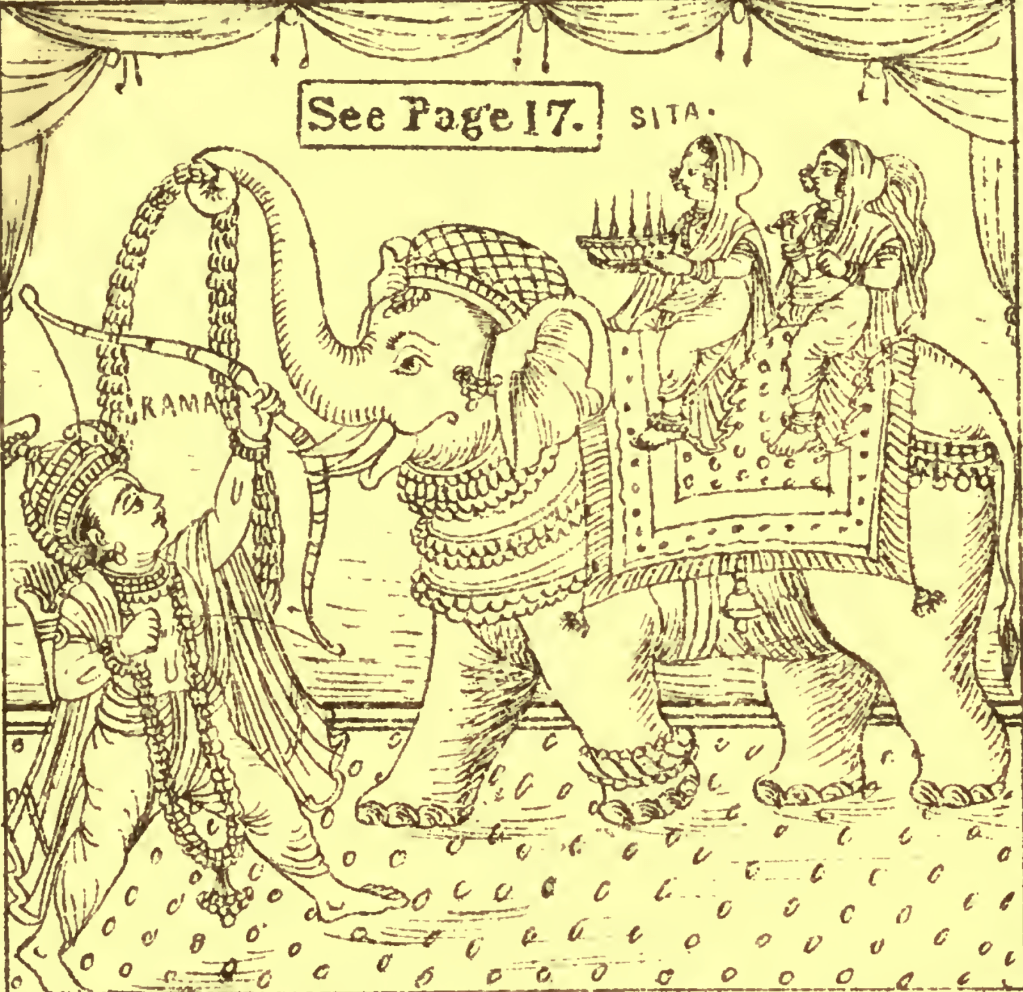
While he was lifting it up, it fell heavily on his breast, and consequently he panted for breath and implored others to help him, when Rama immediately removed it, at the suggestion of Viswamitra, and broke it into two pieces. Sita, who was seated all the time on the back of an elephant, put the garland in her hands round the neck of Rama, when Ravana returned to Lanka with shame and confusion.
Janak informed Dasharatha of the swayamvar and requested him to come to Mithila to celebrate the marriage of his son with Sita. Dasharatha, full of joy, went to Mithila with his wives, sons, and courtiers. Soon after, Rama was married to Sita, and Urmila, Maliti and Shrutakirti, the other daughters of Janak, to Lakshman, Bharat, and Shatrughna respectively.
Rama knew that Parashuram would come and fight with him on account of the dhanusha he had broken; and, therefore, he did not like to stay any longer at Mithila. But at the request of his father-in-law he stayed there for a few days more. In the meantime, Narada went to Parashuram and told him that a man called Rama had broken his dhanusha. He was greatly enraged at this news; and having come to Mithila, he kicked up a great row about the dhanusha.
To foment the quarrel Narada told him that Rama had broken the bow and that he was so proud that he did not even come down to receive him. Parashuram got indignant and let off arrows at Rama, which melted away as soon as the latter saw them. Parashuram, knowing that his incarnation was over, laid down his arms and weapons, when Rama came down and embraced him heartily.
But even in the midst of celebration, destiny was already preparing the turn that would send Rama into exile. Until next time, Jai Shree Ram!
|| OM SAI SHRI SAI JAI JAI SAI ||
|| SHRI SATCHIDANANDA SADGURU SAINATH MAHARAJ KI JAI ||
Note: This narration is based on Ramavijaya: The Mythological History of Rama (Bombay, 1891, Dubhashi & Co.), a public domain text shared here for free reading.
 Letters From Shirdi
Leave a comment