
We’ve seen how Ravana and his brothers rose with divine blessings and dangerous pride. Now, destiny shifts to Ayodhya, where a king longs for sons. At Ayodhya, Dasharatha married more wives, Sumitra and Kaikeyi. He was an accomplished prince and very dexterous in the use of dhanushabans, bows and arrows. One day, he dreamt a dream in which he found that he had killed an innocent man and woman. Whereupon, he asked his guru Vashishta, a rishi to interpret the dream, when the latter said to him, “This dream indicates bad omens. I, therefore, advise you to kill a few stags and perform a penance, so that nothing bad may happen to you.” Listening to the advice of the guru, Dasharatha went to a forest for hunting stags; and though he worked hard the whole day, he did not come across any stag.
At the sunset he lay in wait at a lake, anxiously expecting a stag there. But, in the meantime, a man called Shravan came there with a kavada, a bamboo lath provided with slings at each end for the conveyance across the shoulder of pitcher, across his shoulders, in which his helpless old mother and father were seated by him. His parents, being thirsty, asked their son to fetch some water for them. Whereupon Shravan placed the kavada on the ground, and taking a goblet in his hand, went to the lake; but whilst he was taking the water, the king took him for a stag and discharged an arrow at him, which passed through his heart. Dasharatha came where he was lying and became extremely sorry for the accident.
Then Shravan said to him, “I shall not now live. Please, therefore, take some water in this goblet and give it to my parents, as they are very thirsty; and as soon as I hear that they have quenched their thirst, I shall instantly die. They are very old and cannot walk; I carry them in a kavada across my shoulder. Oh, my good king, take care of these poor creatures. There is no one to look after them.” Dasharatha sighed and wept, but the loss was irreparable. The king then took some water in the goblet and stood where the kavada was placed without speaking a word. The old woman and the man, who were blind, taking him for Shravan, said, “Child, why dost thou not speak? Art thou angry with us because we sent thee to the lake at this hour? Child, thou art always obedient to us, and what has irritated thee today?”
These words made Dasharatha shed tears, and at last he broke the sad news to the old parents of Shravan, when they cried violently and said, “Shravan, none can get a son like thee in this world. We feel much for thee and die with thee. Oh, we cannot bear this grief. You, the murderer of our child, we curse you and say that you will also die of grief for your son in the same way we do.” So saying, they instantly expired.
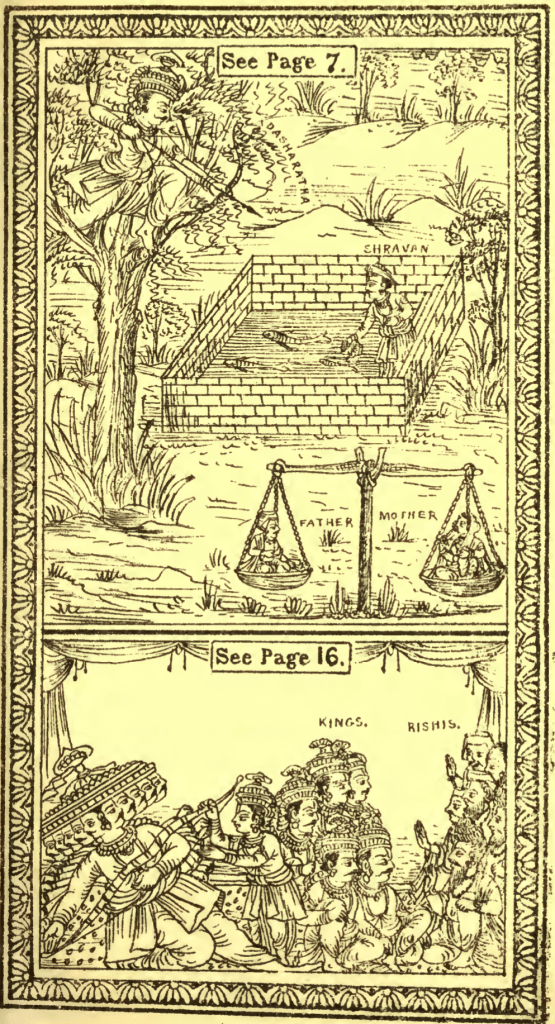
Dasharatha grieved much for Shravan and his old parents, whom he had killed by his own hands, and performed their funeral ceremonies. The king then returned to Ayodhya and informed Vashista of what had happened.
At this time, there was a great famine in the country, as there was no rain for twelve years; and consequently, the subjects of the king died of thirst and hunger one after another. The rain was stopped because Vrashaparva, a powerful demon, fought with the Gods in heaven with the assistance of his guru, Shukra. Indra, therefore, sent a chariot to Dasharatha and requested him to come up to heaven and kill the demon, informing him at the same time that the rain was stopped on account of the battle with the Gods.
Whereupon, Dasharatha went by the chariot to Indra with his favourite wife, Kaikeyi. Immediately on his arrival there, Dasharatha fought with the demons and killed a large number of them, when Vrashaparva made an attack upon the king, but he was also repulsed. His guru, Shukra, then took the field and discharged arrows at the king, when the chariot of the king was about to give way; but his wife, Kaikeyi, supported it by one of her hands, of which the king knew nothing. Dasharatha bravely continued the fight and cut off the guru’s horse and mugut, a tiara. Shukra fled in alarm with the other demons.
When everything was over, the king was informed that the victory he had gained in the battle with the demons was due to his wife, Kaikeyi. The king was pleased with her and asked her what reward she wanted from him. Kaikeyi replied, “Kindly give me your promise that you will give me whatever I will ask from you; and I shall ask you for it whenever I like.” The king generously gave the promise she required.
The victory gained by Dasharatha in the battle with the demons was due to Kaikeyi, because when she was young, a Tapaswi, a sage, came to her parents and stayed with them for a day. At the time of his bathing her mother told her to go and rub his body with scents. She accordingly went to him with the scents; but finding that the Tapaswi was absorbed in meditation, she applied soot to his face instead of the scents.
Having found that the soot had been applied to his face, he got indignant and cursed the doer of the mischief and said, “Whoever has applied this soot to my face will always be looked upon by all people with contempt.” Her mother was afraid of this curse; and finding that it was her daughter’s doing, she threw herself at the feet of the Tapaswi and implored him to make the curse a little milder. Whereupon the Tapaswi said, “The hand with which your daughter has applied the soot to my face will give success to her husband in a battle which he will fight with demons, and for which only she will be praised by all.”
After the battle was over, Brahaspati asked the king whether he had any issue. Dasharatha replied, “I am very sorry that I have no issue.” The god blessed him and said, “Vishnu, the protecting God of the universe, will be born to you.” Indra said, “There is a Rishi called Shringa Rishi, who has not yet seen a human face. He lives with his father in a forest; and if he is induced and brought to Ayodhya, his father, who is a great Tapaswi, will come there in search of his son; and by his blessing you will get children. I shall, therefore, send a devangana, celestial woman, to the forest to charm him with her beauty and singing, so that he may easily follow her.” Dasharatha thanked Indra and returned to Ayodhya with Kaikeyi.
Indra accordingly sent a devangana to the forest. The young Rishi was placed by his father, Vibhandak, on a mala, mountain, in order that he might not be devoured by lions and tigers. The young boy, having seen the woman, was at first frightened; but soon after, he was charmed with her beauty and singing. As his father was absent, she brought him to Ayodhya.
Dasharatha cordially received him; and shortly after, he gave away his foster-daughter in marriage to him. Vibhandak knew by his yoga, a union with Bramhan through abstract meditation, that his son was taken to Ayodhya in his absence, and got so much enraged that he immediately went to that city to curse the woman to death. Dasharatha treated him with respect; and on finding that his son was married to the foster-daughter of the king, he was pleased with him and blessed him, saying that four mighty sons would be born to him.
The Rishi then made a havan, a large hole made in the ground for receiving and preserving consecrated fire. The god Agni, Fire God, came out of it and entrusted to Vashista a thali, cooking pot full of payas, a dish composed of rice, sugar, milk; sweet pudding and told him to divide it equally among the three wives of the king, so that they might get sons as soon as they partook of it.
Vashista made three pindas, lumps, of the payas and gave the largest of them to Kausalya, the eldest wife of Dasharatha, and the other two to Sumitra and Kaikeyi. Kaikeyi, the third wife of the king, became jealous and said that she was entitled to the largest pinda, because she supported the chariot of the king by her own hands, which was about to give way during the battle with the demons.
While she was thus quarrelling about it, a ghar (eagle, kite) from above snatched the pinda from her hands and flew in the air with it. She became exceedingly sorry and began to weep, when Dasharatha prevailed upon Kausalya to divide her pinda into two halves and give one to Kaikeyi and keep the other for herself. Kausalya accordingly did it; and Sumitra also did the same thing in compliance with the wishes of the king. Thus, Kaikeyi got one full pinda for herself, which she ate heartily. Kausalya and Sumitra ate their own halves.
Soon after, the three ladies became pregnant. The pinda which was snatched by the ghar, eagle, from the hands of Kaikeyi fell by a blast of wind into the hands of Anjani, the wife of a monkey called Kesari. She also swallowed up the pinda and became pregnant.
This is where Chapter 3 ends. In the next chapter we will read the story of the child born to Anjani. Until next time, Jai Shree Ram!
|| OM SAI SHRI SAI JAI JAI SAI ||
|| SHRI SATCHIDANANDA SADGURU SAINATH MAHARAJ KI JAI ||
Note: This narration is based on Ramavijaya: The Mythological History of Rama (Bombay, 1891, Dubhashi & Co.), a public domain text shared here for free reading.
Also, as per scriptures and popular belief, Dasharatha offers half of this payasam to Kausalya, a quarter to Sumitra (i.e., literally ‘half of that which remained’), an eighth to Kaikeyi (i.e., again, ‘half of that which remained’), and then, upon reflection, gives the final eighth to Sumitra again. Consequently, Kausalya gives birth to Rama, Sumitra to the twins Lakshmana and Satrughna, and Kaikeyi to Bharata. This book mentions Bharat and Shatrughan were twins of Kaikeyi.
 Letters From Shirdi
Leave a comment